
Search
Remove Ads
Advertisement

 This answer was generated by
 Search Results

Article
Norse-Viking Symbols & Meanings
A symbol is an image or object which represents an abstract concept, often having to do with one's religious beliefs. Every civilization, from the most ancient to the present, has made use of symbols to make the abstract concrete and visible...
Article
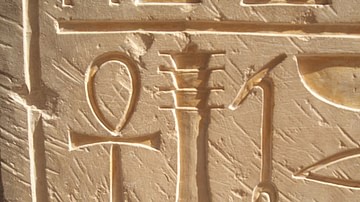
Ancient Egyptian Symbols
Religion in ancient Egypt was fully integrated into the people's daily lives. The gods were present at one's birth, throughout one's life, in the transition from earthly life to the eternal, and continued their care for the soul in the afterlife...

Definition
Greek Mythology
Greek mythology was used as a means to explain the environment in which humankind lived, the natural phenomena they witnessed and the passing of time through the days, months, and seasons. Greek myths were also intricately connected to religion...

Definition
Mythology
Myths are a part of every culture in the world and are used to explain natural phenomena, where a people came from and how their civilization developed, and why things happen as they do. At their most basic level, myths comfort by giving...

Definition
Chitrali Mythology
Chitrali mythology developed in the region of Chitral, the tallest portions of the Hindu Kush mountains, where the Chitrali people, at the juncture of South, Central, West, and East Asia, were exposed to many external cultural influences...

Definition
Roman Mythology
The ancient Romans had a rich mythology and, while much of it was derived from their neighbors and predecessors, the Greeks, it still defined the rich history of the Roman people as they eventually grew into an empire. Roman writers such...

Article
The Egyptian Amulet: Pious Symbols of Spiritual Life
Material Objects & Cultures Material objects convey volumes about the people who possessed them. Cultures and societies in every generation are in part classified - either correctly or incorrectly - by the objects or symbols they select...

Article
Cultural Links between India & the Greco-Roman World
Cyrus the Great (558-530 BCE) built the first universal empire, stretching from Greece to the Indus River. This was the famous Achaemenid Empire of Persia. An inscription at Naqsh-i-Rustam, the tomb of his able successor Darius I (521-486...

Article
A Visual Who's Who of Greek Mythology
Achilles The hero of the Trojan War, leader of the Myrmidons, slayer of Hector and Greece's greatest warrior, who sadly came unstuck when Paris sent a flying arrow guided by Apollo, which caught him in his only weak spot, his heel. Adonis...

Interview
Interview: Egyptian Mythology by Garry Shaw
World History Encyclopedia is joined by Egyptologist and author Garry Shaw to chat about his new book Egyptian Mythology: A Traveller's Guide from Aswan to Alexandria. Kelly (WHE): Do you want to start with telling us what the book is about...
