
Search

 This answer was generated by
 Search Results
Article
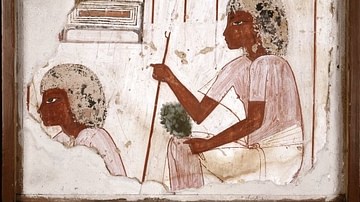
Immortality of Writers in Ancient Egypt
For the ancient Egyptians, life on earth was only one part of an eternal journey which continued after death. One's purpose in life was to live in balance with one's self, family, community, and the gods. Any occupation in Egypt was considered...

Image
The People of France Recognize the Supreme Being and the Immortality of the Soul
A stamp from Revolutionary France in 1794, referencing Maximilien Robespierre's Cult of the Supreme Being. It reads: "The People of France Recognize the Supreme Being and the Immortality of the Soul".
Bibliothèque nationale de France.

Video
The Epic of Gilgamesh - An Ancient Tale of a King Searching for Immortality
Gilgamesh is a semi-mythical king of Uruk, an ancient city of Mesopotamia, and is best known as the star of the first epic poem ever written, the Epic of Gilgamesh, where he searches for immortality after the death of his friend Enkidu. Even...

Article
Religion in Ancient China
Religious practices in ancient China go back over 7,000 years. Long before the philosophical and spiritual teachings of Confucius and Lao-Tzu developed or before the teachings of the Buddha came to China, the people worshipped personifications...

Definition
Gilgamesh
Gilgamesh is the semi-mythic King of Uruk best known as the hero of The Epic of Gilgamesh (c. 2150-1400 BCE) the great Babylonian poem that predates Homer's Iliad and Odyssey by 1500 years and, therefore, stands as the oldest piece of epic...

Definition
Pythagoras
Pythagoras (l.c. 571 to c. 497 BCE) was a Greek philosopher whose teachings emphasized the immortality and transmigration of the soul (reincarnation), virtuous, humane behavior toward all living things, and the concept of "number" as truth...

Article
Plato's Greater, Better World in The Last Days of Socrates
The Last Days of Socrates is a modern-day title for the collection of four Socratic dialogues by the Greek philosopher Plato – the Euthyphro, Apology, Crito, and Phaedo – telling the story of the trial, imprisonment, and death of Socrates...

Article
The Life of Hercules in Myth & Legend
Hercules is the Roman name for the Greek hero Herakles, the most popular figure from ancient Greek mythology. Hercules was the son of Zeus, king of the gods, and the mortal woman Alcmene. Zeus, who was always chasing one woman or another...

Article
The Mesopotamian Pantheon
The gods of the Mesopotamian region were not uniform in name, power, provenance or status in the hierarchy. Mesopotamian culture varied from region to region and, because of this, Marduk should not be regarded as King of the Gods in the same...
Article
The Myth of Adapa
The Myth of Adapa (also known as Adapa and the Food of Life) is the Mesopotamian story of the Fall of Man in that it explains why human beings are mortal. The god of wisdom, Ea, creates the first man, Adapa, and endows him with great intelligence...
