
Search
Remove Ads
Advertisement

 This answer was generated by
 Search Results
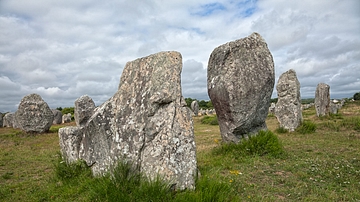
Image
Carnac Stones
Stone megaliths at Carnac, Brittany, France.

Definition
Carnac
Carnac, located on the north-west coast of France, is the site of the largest concentration of megalithic monuments in the world. Over 100 monuments, which include burial mounds, stone tombs, enclosures, and linear arrangements of menhirs...

Article
Legends of the Rollright Stones, Oxfordshire
The Rollright Stones is the collective name for a group of enigmatic prehistoric monuments located next to an ancient ridgeway known as the Jurassic Way, on the border between the English counties of Oxfordshire...
Image
Kermario Dolmen, Carnac
The Kermario Dolmen at Carnac, north-west France. The granite structure was created as a burial chamber and would have originally been completely covered by an earth mound. The megaliths of Carnac were built between 5,000...
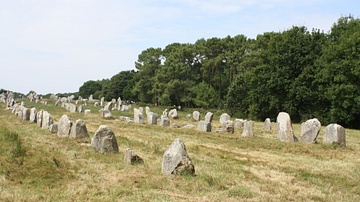
Image
Menhir Alignments, Carnac
A section of the Carnac Alignments in north-west France. These granite stone menhirs were placed in long parallel lines sometime between 5,000 and 3,000 BCE. Their purpose was most likely as markers of processional ways...
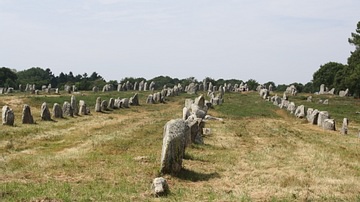
Image
Granite Menhirs, Carnac
A section of the Carnac Alignments in north-west France. These granite stone menhirs were placed in long parallel lines sometime between 5,000 and 3,000 BCE. Their purpose was most likely as markers of processional ways...
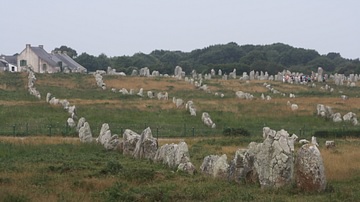
Image
Carnac Alignments, France
A section of the Carnac Alignments in north-west France. These granite stone menhirs were placed in long parallel lines sometime between 5,000 and 3,000 BCE. Their purpose was most likely as markers of processional ways...
Image
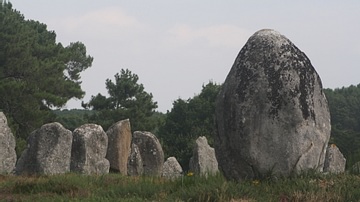
Large Menhir, Carnac Alignments
A section of the Carnac Alignments in north-west France. These granite stone menhirs were placed in long parallel lines sometime between 5,000 and 3,000 BCE. Their purpose was most likely as markers of processional...

Article
Christiane Desroches Noblecourt - Strong as the Stones she was able to move
Her name echoes down the corridors, in classrooms and in books, Christiane Desroches Noblecourt was a great French Egyptologist and, in the opinion of the writer, a woman strong...

Image Gallery
A Gallery of Standing Stones, Cairns, and Castles of Scotland
Scotland has a rich history dating back to seasonal settlements around c. 10,500 BCE and permanent residences by c. 7000 BCE. Neolithic ceremonial sites such as the Ness of Brodgar were established...
