
Search
Did you mean: Hathor?
Remove Ads
Advertisement

 This answer was generated by
Search Results
Image
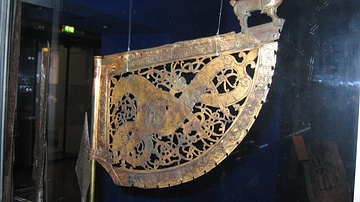
Weather Vane in Ringerike Style
Copper-gilt weather vane from Söderala, Hälsingland, Sweden, dating to the Viking Age (c. 790-1100 CE). The style of its open-work pattern reminds of the Urnes style ornamentation, but the animal and its axial form...
Image
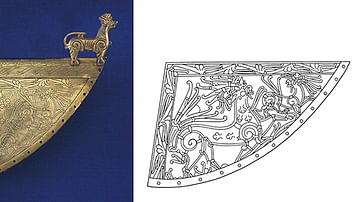
The Heggen Weather Vane
This wind vane (Old Norse veðrviti) glittered at the prow of a longship in the 11th century. Such vanes are very decorative - here a motif of the great beast - and mark of high status in the Viking Age and Early Middle Ages...

Article
Pirate Clothing in the Golden Age of Piracy
Pirates have gained a reputation for wearing bright and distinctive clothing and accessories during the Golden Age of Piracy (1690-1730) even if, in reality, most of what we think they wore comes from works...

Article
The Mesopotamian Pantheon - The Ancient Gods and Goddesses of the Near East
The gods of the Mesopotamian region were not uniform in name, power, provenance or status in the hierarchy. Mesopotamian culture varied from region to region and, because of this...

Article
The Athenian Calendar
The term "Athenian Calendar" (also called the "Attic Calendar") has become somewhat of a misnomer, since Ancient Athenians never really used just one method to reckon the passage of time. Athenians, especially from the 3rd...

Definition
Gallipoli Campaign - Churchill's Folly in World War I
The Gallipoli Campaign took place in Turkey in 1915-16 during the First World War (1914-18). This major expedition involved British, French, Australian, and New Zealand (ANZAC) troops and was launched...

Article
Battle of Passchendaele - Haig's Folly in the Mud of Flanders
The Battle of Passchendaele (October-November 1917), the final stage of the Third Battle of Ypres, took place in Flanders, Belgium, during the First World War (1914-18). The aim of the Allied...

Definition
Ferdinand Magellan
Ferdinand Magellan, or Fernão de Magalhães (c. 1480-1521), was a Portuguese mariner whose expedition was the first to circumnavigate the globe in 1519-22 in the service of Spain. Magellan was killed on the voyage in what is...

Definition
Spanish Galleon
The Spanish galleon (Spanish: galeón, nao, or navío) was a particularly large type of galleon used for both carrying cargo and as a warship armed with up to 60 cannons. Used from the mid-16th century until the early 19th century...

Definition
Plymouth Colony
The Plymouth Colony (1620-1691) was the first English settlement in the region of modern-day New England in the United States, settled by the religious Separatists known as the “pilgrims” who crossed the Atlantic Ocean on the...
