
Search
Did you mean: Phidias?
Remove Ads
Advertisement

 This answer was generated by
Search Results

Definition
Roman Science
The Romans assimilated earlier Greek science for their own purposes, evaluating and then accepting or rejecting that which was most useful, much as they did in other fields such as warfare, art, and theatre. This assimilation of...
Definition
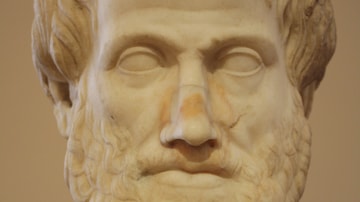
Aristotle
Aristotle of Stagira (l. 384-322 BCE) was a Greek philosopher who pioneered systematic, scientific examination in literally every area of human knowledge and was known, in his time, as "the man who knew everything" and later simply...

Article
Discovery of X-Rays
The discovery of X-rays – a form of invisible radiation that can pass through objects, including human tissue – revolutionised science and medicine in the late 19th century. Wilhelm Conrad Röntgen (1845-1923), a German scientist...

Image
10 Women Scientists Who Changed the World - Discoveries That Transformed Science and Medicine
Throughout history, women in science have made groundbreaking discoveries, often pushing the boundaries of knowledge despite being overlooked and underrecognized. Many...

Definition
Galileo Galilei
Galileo Galilei (1564-1642) was an Italian mathematician, physicist, astronomer, and natural philosopher. He created a superior telescope with which he made new observations of the night sky, notably that the surface of the Moon...

Definition
Ancient Greek Science
Ancient Greek science is a modern term for the application of systematic inquiry into the individual, the world, and the universe, which began in Ionia in the 6th century BCE with Thales of Miletus (l. c. 585 BCE) and continued...

Definition
Isaac Newton
Isaac Newton (1642-1727) was an English mathematician and physicist widely regarded as the single most important figure in the Scientific Revolution for his three laws of motion and universal law of gravity. Newton's laws became...

Definition
Alchemy
Alchemy is an ancient practice aimed at recreating precious substances using recipes and transformative materials such as the philosopher's stone. Alchemists believed that materials like gold, silver, gems, and purple dye could be recreated...

Definition
Anaximander
Anaximander of Miletus (l. c. 610 - c. 546 BCE) was one of the early Pre-Socratic Philosophers who lay the foundation for the deveopment of Western Philosophy. He was a student of Thales of Miletus (l. c. 585 BCE), recognized as the...

Definition
Eratosthenes
Eratosthenes (l. c. 276-195 BCE) was a Greek astronomer, geographer, mathematician, and poet best known for being the first to calculate the circumference of the earth and its axial tilt. He is also recognized for his mathematical...
