

This water basin was originally cut from a single basalt block. When it was discovered, it was completely shattered into several pieces. It was located in one of the courtyards of the temple of Assur. On the corners and in the center of each side of the walls, we see water gods holding overflowing water jugs. Streams of water flow from the sky above into the jugs and downwards to the earth below. Two priests wearing fish skins hold small buckets to purify the central figure of the water god. A cuneiform inscription repeated several times invokes the name of Sennacherib (705-681 BCE). The interior of the basin is undecorated. Its location and decoration suggest that the water basin was used for cultic purification rites. Neo-Assyrian period, reign of King Sennacherib, 704-681 BCE. From Assur, northern Mesopotamia, Iraq. (The Pergamon Museum, Berlin. August 11, 2014.
Related Content

Sennacherib

Assur

The Mutual Destruction of Sennacherib & Babylon

Neo-Assyrian Empire

Assyria
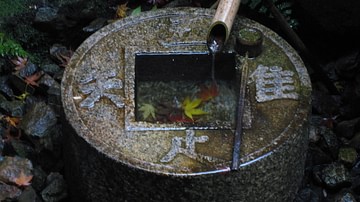
Water Basin, Ryoanji
Cite This Work
APA Style
Amin, O. S. (2014, September 09). Neo-Assyrian Water Basin from Assur. World History Encyclopedia. https://www.worldhistory.org/video/531/neo-assyrian-water-basin-from-assur/
Chicago Style
Amin, Osama SM. "Neo-Assyrian Water Basin from Assur." World History Encyclopedia, September 09, 2014. https://www.worldhistory.org/video/531/neo-assyrian-water-basin-from-assur/.
MLA Style
Amin, Osama SM. "Neo-Assyrian Water Basin from Assur." World History Encyclopedia, 09 Sep 2014, https://www.worldhistory.org/video/531/neo-assyrian-water-basin-from-assur/.
