
Search Images
Browse Content (p. 896)
Image
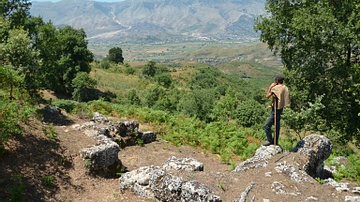
Antigoneia of Epirus, Albania
Antigoneia of Epirus, Albania. The city was founded in 295 BCE by Pyrrhus, the king of the Molossians, who named it after his wife Antigone, daughter of Berenice I and step-daughter of Ptolemy I of Egypt.
Image
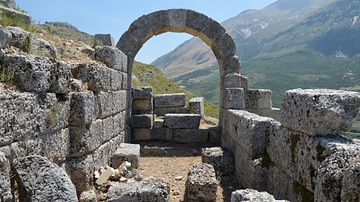
City Gate of Amantia, Albania
One of the city gates of Amantia with an archway belonging to the second phase of construction of the city. The city was protected by a 2,100 m long, walled enclosure equipped with three monumental gates.
Image
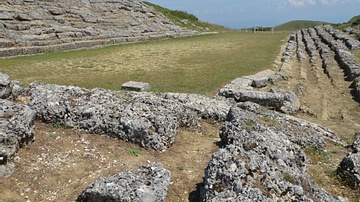
Stadium of Amantia, Albania
The Stadium of Amantia was built in the 3rd century BCE. Its stone rows, set in the form of an extended horseshoe, followed a track 12.5m wide and about 60m long. It had 17 rows on one side and 8 on the other and could accommodate about 4000...
Image
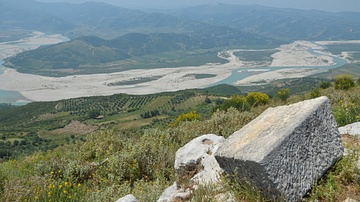
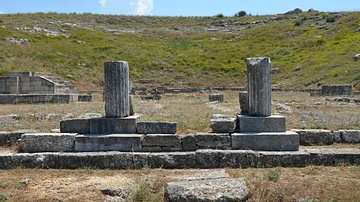
View towards the Vjosa Valley from Byllis, Albania
View towards the Vjosa valley from Byllis, Albania. The site occupied a dominant position on the summit of a hill, over the road from Apollonia to Epirus and into Macedonia.
Image
Theatre of Byllis, Albania
The Theatre was built against a natural slope and dates from the middle of the 3rd century BCE. With its 40 steps of seats, it had a capacity of 7,500 spectators.
Image
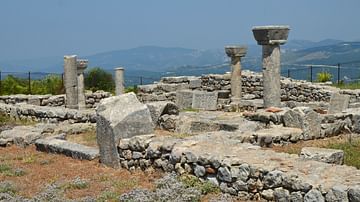
Byzantine Basilica in Byllis, Albania
The remains of Basilica C in Byllis (Albania), a church of average dimensions built in 525-550 CE and paved with mosaics. The Basilica had three naves, a narthex covered by a gallery, preceded by a portico and several annexes.
Image
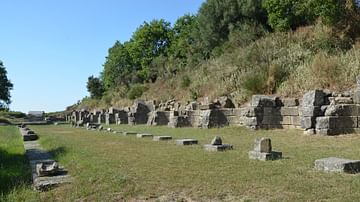
Large Stoa of Apollonia, Albania
The large Stoa of Apollonia in Albania was built in the 4th century BCE. It is the best-preserved monument from the Classical period in the Agora and was used up to the 2nd century CE. It has a rectangular plan measuring 72.2m by 10.5m, divided...

Image
Earth's Solar System
Earth's solar system by NASA and Rawpixel.
Image
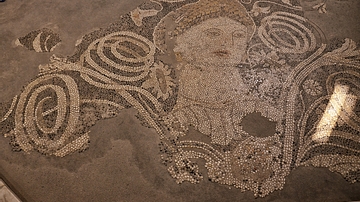
The Beauty of Durrës Mosaic
Mosaic called "The Beauty of Durrës", from Epidamnos/Dyrrhachium, 4th century BCE. National Museum of History in Tirana, Albania.
Image
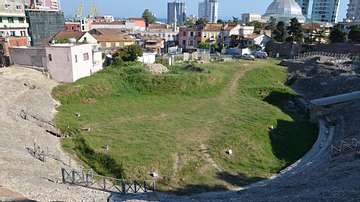
Amphitheatre of Durrës (Dyrrachium)
The Amphitheatre of Durrës (Roman Dyrrachium) in Albania was built in the 2nd century CE and held 15,000 to 20,000 people. It is among the largest monuments of antiquity to have survived on Albanian territory.
