
Search Images
Browse Content (p. 144)

Image
Civilians Digging Defences, Moscow, 1941
Civilian men and women digging defensive anti-tank ditches in Moscow. The Soviet capital was threatened during Operation Barbarossa, the attack by Adolf Hitler (1889-1945) on the USSR from June to December 1941.

Image
German Troops on Horseback, Operation Barbarossa
A photograph showing German troops on horseback passing a destroyed Soviet T-26 tank during Operation Barbarossa, the attack by Adolf Hitler (1889-1945) on the USSR from June to December 1941. Horses were used by both sides for want of mechanised...

Image
Burning Russian Village, Operation Barbarossa
A photograph showing a burning Russian village during Operation Barbarossa, the attack by Adolf Hitler (1889-1945) on the USSR from June to December 1941. (Imperial War Museums)

Image
German Motorcyclists, Operation Barbarossa
A photograph of German Waffen SS motorcyclists during Operation Barbarossa, the attack by Adolf Hitler (1889-1945) on the USSR from June to December 1941. (Imperial War Museums)
Image
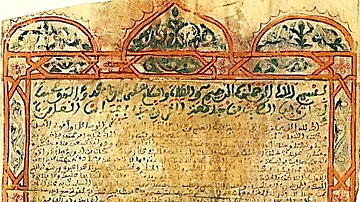
Oldest Known Medical Degree
The oldest known and documented medical degree in the world. It was awarded by the University of al-Qarawiyyin, Fez, Morocco, to Doctor Abdellah Ben Saleh Al Koutami in 1207.

Image
Water Clock, Al-Qarawiyyin Mosque
This reconstruction of the 14th-century water clock from the Dar al-Muwaqqit of the al-Qarawiyyin Mosque (Fez, Morocco) is now on display at the Istanbul Museum of the History of Science and Technology in Islam. The Dar al-Muwaqqit is a...

Image
Figure of Fatima Al-Fihri from the Jordan Museum
Figure of Fatima Al-Fihri (c. 800-880) from the Jordan Museum, Amman, Jordan. Fatima Al-Fihri was a Muslim woman, scholar and philanthropist who is credited with founding the world’s oldest, continuously running university during the 9th...

Image
Fountain, Al-Qarawiyyin Mosque Complex
The fountain in the courtyard of Al-Qarawiyyin mosque complex, Fez, Morocco.
Image
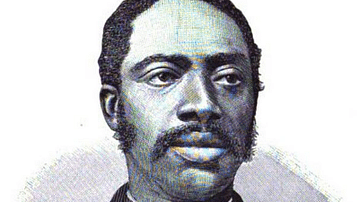
John Wesley Cromwell
John Wesley Cromwell (l. 1846-1927), educator, historian, lawyer, and activist, from an 1887 sketch in Men of Mark: Eminent, Progressive and Rising by William J. Simmons and Henry McNeal Turner, G. M. Rewell & Company, 1887.

Image
Nat Turner's Rebellion
Nat Turner's Rebellion as depicted in Samuel Warner's Authentic and Impartial Narrative of the Tragical Scene Which Was Witnessed in Southampton County, 1831.
Library of Congress, Washington, D.C.
