
Search Images
Browse Content (p. 1361)

Image
Votive Crown from Visigothic Spain
This Visigothic votive crown is from 7th-century Spain, and it was made from gold, elements of nacre, amethysts, sapphires, emeralds, and glass beads. It was discovered in 1860 in the "Treasure of Guarrazar" near...
Image
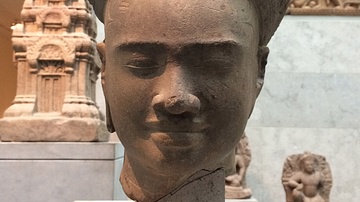
Masculine Divinity in the Style of Pre Rup
This large head is that of a masculine divinity in the style of Pre Rup. It comes from what is present-day Cambodia. It is made from sandstone and dates from the third quarter of the 10th century CE, but its...
Image
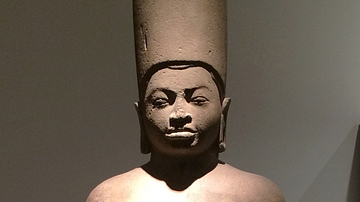
Thai Vishnu Statue
This sculpture of Vishnu made from sandstone is from what is present-day Thailand. It likely comes from the province of Prachinburi in the vicinity of Dong Si Maha Phot. It dates from the 7th-8th century CE. (Musée Guimet...
Image
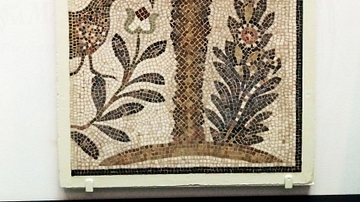
Jewish Mosaic of a Date Palm
This mosaic was once part of the mosaic found in an ancient synagogue in what's present-day Tunisia. This specimen dates from c. 550 CE and is made of stone and mortar. The date palm likely symbolized the Tree of Knowledge...
Image
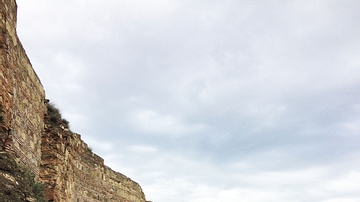
Narikala Fortress in Tbilisi
This photograph shows a portion of the Narikala Fortress, which runs parallel to the city of Tbilisi, Georgia and the Kura River. The fortress was first built in the 4th century CE and later expanded by the Umayyads...
Image
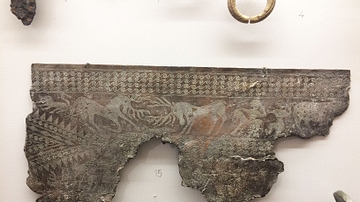
Bronze Belt from Ancient Georgia
This is a belt made of bronze that was uncovered in eastern Georgia and dates from the second half of the second millennium BCE. It was made by the Trialeti Culture. (Georgian National Museum, Tbilisi)
Image
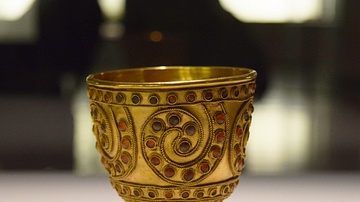
Ancient Goblet from Georgia
This goblet is made on a lath from a single piece of gold. It was found in Trialeti barrow no. 17, in eastern Georgia, and dates from the 18th-17th centuries BCE. It was made by craftsmen belonging to the Trialeti Culture...
Image
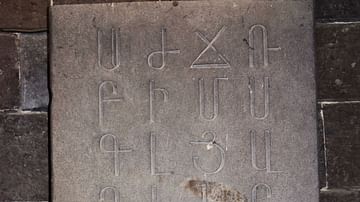
Monument to Armenian Alphabet at Oshakan
Mesrop Mashtots (c. 362-440 CE) is credited with the creation of the Armenian alphabet around 405 CE. Originally, the Armenian alphabet had 36 letters, but it presently has 39. It is read from left to right...
Image
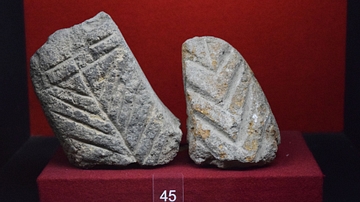
Fragments of Urartian Idols
These are fragments of two carved Urartian idols made from stone. They were excavated at Karmir Blur, Armenia and date from the 7th century BCE. (Erebuni Historical and Archaeological Preserve, Yerevan, Armenia.)
Image
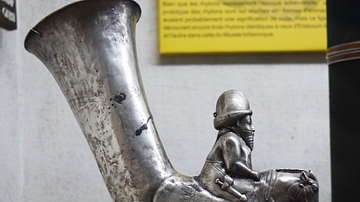
Horse Rider Rhyton
This horse rider ryhton was discovered while archaeologists excavated the ancient Erebuni Fortress, which is located in present-day Yerevan, Armenia. It dates from the 5th century BCE when Erebuni was under Persian control and...
