
Search Images
Browse Content (p. 1306)
Image
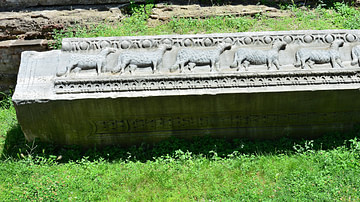
Remnants of Theodosius' Hagia Sophia
Remnants of Theodosios' Hagia Sophia. A lamb relief representing 12 apostles. 5th. century CE, Hagia Sophia, Istanbul, Turkey. The first name of the Church was ‘’Megale Ekklesia’’ which means ‘’the Grand Church’’...
Image
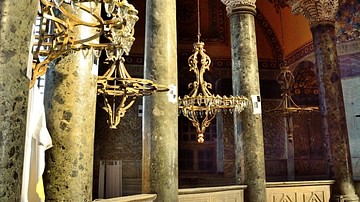
Columns of Hagia Sophia
Columns of Hagia Sophia, 6th century CE, Hagia Sophia, Istanbul, Turkey. In Hagia Sophia, there are 140 monolithic columns which were brought from different places of the world.
Image
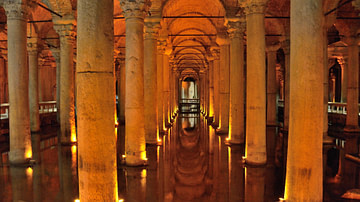
Columns of Basilica Cistern, Istanbul
Located across the Hagia Sophia Museum, Yerebatan Sarayi is also known as the Basilica Cistern because of a basilica that was once located nearby as a cultural centre. It is the largest surviving underground cistern...

Image
Floor Chamber, Rock-Cut Tombs of Qizqapan
This is the right burial chamber at the rock-cut tombs of Ashkawt-i Qizqapan (Kurdish: The Cave of the Ravisher or the Cave of the Raped/Abducted Girl). This rectangular coffin was carved into the rocky floor...
Image
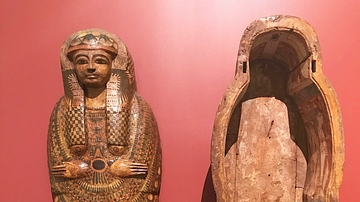
Coffin of the Chantress of Amun
This is the coffin of the "Chantress of Amun," and it dates c. 1070-945 BCE or Egypt's Third Intermediate Period (c. 1070-712 BCE). It is made of wood with a painted gesso relief. Ancient Egyptian coffins sheltered...
Image
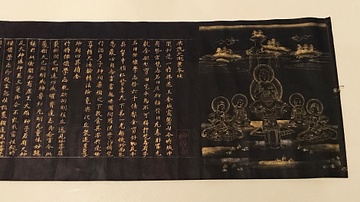
Illuminated Sutra from Jingoji Temple
This illuminated sutra is from Jingoji Temple in Kyoto, Japan, and it dates to 1179 CE, which corresponds to Japan's Heian period. It is made of gold and silver on indigo paper. (Iris & B. Gerald Cantor Center...
Image
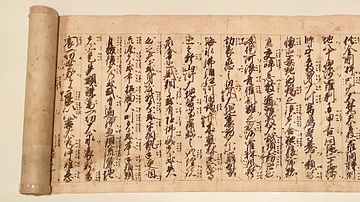
Nehan koshiki
The Nehan koshiki (Koshiki on the Buddha's Passing) is written in Chinese but was recited in Japanese. Koshiki were intended to be understood by the listeners. The development of this genre in the late-10th century CE in Japan represents...
Image
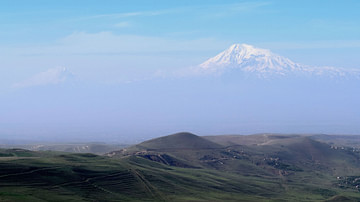
View of Mount Ararat from Armenia
Together, the Ararat Mountains straddle the borders of what are present-day Turkey, Armenia, Iran, and Azerbaijan. Mt. Ararat (“Greater Ararat”) rises to a height of 5,137 m (16,854 ft). Mt. Ararat’s neighboring...
Image
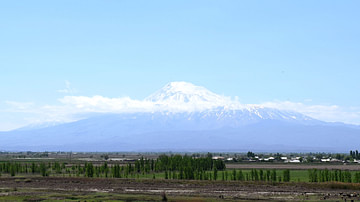
Mount Ararat
Mount Ararat (Armenian: Masis; Turkish: Ağrı Dağı; Kurdish: Çiyaye Agiri) is a dormant, compound volcanic mountain, consisting of two ancient volcanic peaks, located in present-day eastern Turkey very close to the border with Armenia...
Image
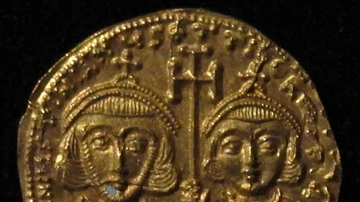
Justinian II & Tiberius
A gold coin depicting Byzantine emperor Justinian II (r. 685-95 & 705-11 CE) and his son Tiberius (d. 711 CE).
