
Search Images
Browse Content (p. 1301)
Image
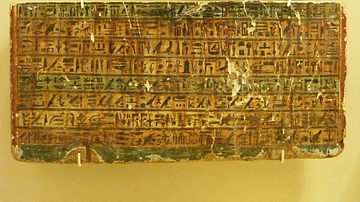
Portion of an Ancient Egyptian Stela
This stela is from the tomb of Espotu, a priest of Amun-Re and son of the second prophet of Amun-Re, Ankhefenkhons. In the inscription, he lists the 22 priesthoods he held, detailing his received a salary for each position. This stela was...
Image
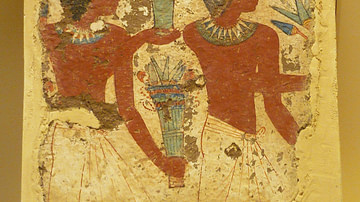
Ancient Egyptian Funeral Painting
Ancient Egyptian tomb painting depicting workmen bringing offerings to a funeral, from the tomb of Nebamun and Ipuky, Thebes, New Kingdom of Egypt (c. 1570 to c. 1069 BCE), 18th Dynasty, c. 1400 BCE.
Royal Ontario Museum, Toronto.
Image
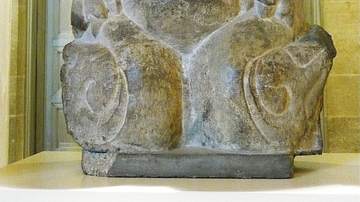
Chinese Pillar Support in the Form of a Kneeling Demon
This pillar support comes from the Buddhist caves at Xiangtangshan, Hebei Province, China and is shaped like a kneeling demon. It is made of limestone and dates from the era of the Northern Qi Dynasty (550-557 CE). (Royal Ontario Museum...
Image
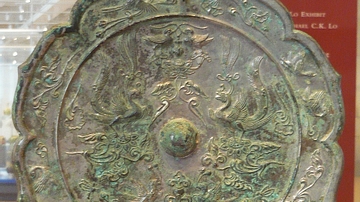
Chinese Bronze Mirror with Phoenix Motif
This Chinese bronze mirror with a phoenix motif dates from the Tang dynasty (618-907 CE). The phoenix was the female counterpart to the male dragon in mythology, and it was also a symbol of Chinese empresses. (Royal Ontario Museum, Toronto)
Image
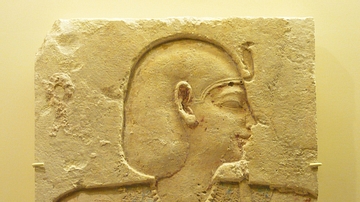
Portrait of Ptolemy I or II of Egypt
This limestone portrait from the Early Ptolemaic Period (323-246 BCE) depicts either Ptolemy I or Ptolemy II of Egypt. Exact provenance is unknown. (Royal Ontario Museum, Toronto)
Image
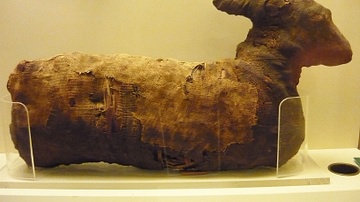
Ancient Egyptian Gazelle Mummy
This gazelle mummy dates from the Late Period (664-332 BCE) of ancient Egyptian history. Its exact provenance is unknown. (Royal Ontario Museum, Toronto)
Image
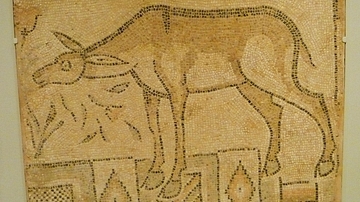
Byzantine Floor Mosaic with Donkey
This floor mosaic with a donkey standing on a mosaic floor is made of limestone tesserae. It was made in the Eastern Mediterranean, c. 500-600 CE. (Royal Ontario Museum, Toronto)
Image
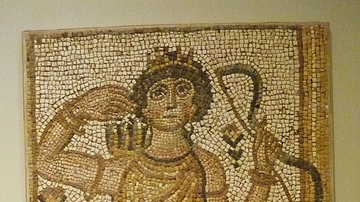
Floor Mosaic with the Goddess Artemis
This floor mosaic with the goddess Artemis is made of limestone tesserae and was made in the Eastern Mediterranean, c. 400-500 CE. (Royal Ontario Museum, Toronto)
Image
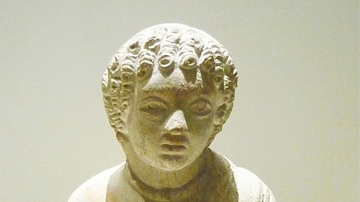
Bust of a Roman Boy on a Pedestal
This type of bust was popular in the Near East during the Roman period. It is made of terracotta and is perhaps from what is prsent-day Jordan. It dates from c. 200-300 CE. (Royal Ontario Museum, Toronto)
Image
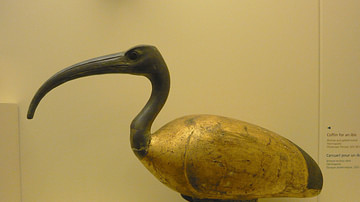
Ibis Coffin from Ancient Egypt
Ancient Egyptian coffin, made of bronze and gilded wood for an ibis, found at Hermopolis, Egypt, Ptolemaic Period (323-30 BCE).
Royal Ontario Museum, Toronto.
