
Celebrate Our Anniversary with Trivia!
Join us on August 23 for a free virtual trivia party featuring questions about ancient civilizations, U.S. history, unusual historical facts, pop culture, and more.


This relief, which is seen on the south side of the Payava Tomb, depicts a seated Persian, apparently a satrap or governor, with attendent figures. The inscriptions in Lycian probably mention the name of the satrap as Autophradates. The Payava tomb is a limestone tomb with gabled roof. It was decorated with reliefs on its four sides and inscribed with Lycian inscriptions. It was made in Lycia; found in Xanthus. Greek Period, circa 375-362 BCE. (The British Museum, London)
About the Author

Related Images
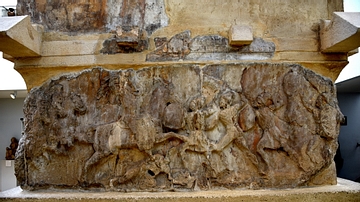
Tomb of Payava, East Side
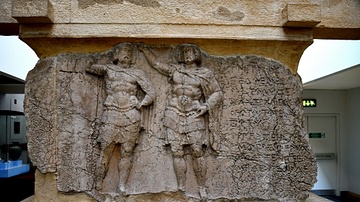
Tomb of Payava, South Side
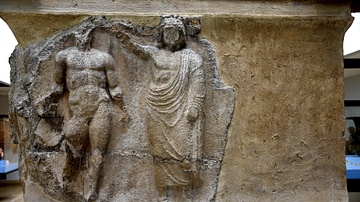
Tomb of Payava, North Side
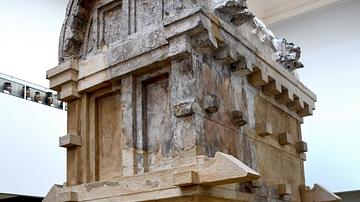
The Payava Tomb
Roman Theatre, Side
Temple of Apollo, Side
Cite This Work
APA Style
Amin, O. S. M. (2016, May 15). Tomb of Payava, West Side. World History Encyclopedia. https://www.worldhistory.org/image/5097/tomb-of-payava-west-side/
Chicago Style
Amin, Osama Shukir Muhammed. "Tomb of Payava, West Side." World History Encyclopedia, May 15, 2016. https://www.worldhistory.org/image/5097/tomb-of-payava-west-side/.
MLA Style
Amin, Osama Shukir Muhammed. "Tomb of Payava, West Side." World History Encyclopedia, 15 May 2016, https://www.worldhistory.org/image/5097/tomb-of-payava-west-side/.
