


This was part of a wall relief and was found inside a well within the courtyard of the temple of Assur at the city of Ashur, the capital city of the Assyrians. The central part of the relief depicts a male deity. Two smaller water deities stand on either side of him. He holds two long branches, and two goats (standing on their hind legs) appear to eat from these branches. Probably this bearded deity represents the god Assur, while the goddesses protect the plant and animal world in this city. Gypsum, from Ashur, northern Mesopotamia, Iraq. First half of the second millennium BCE. (The Pergamon Museum, Berlin).
About the Author

Related Images
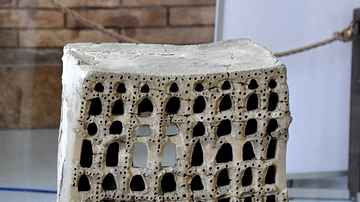
Incense Burner from Assur
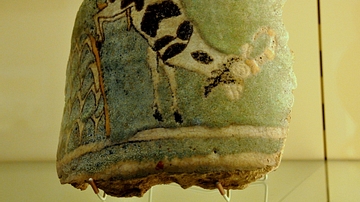
Colored Ceramic Fragment from Assur
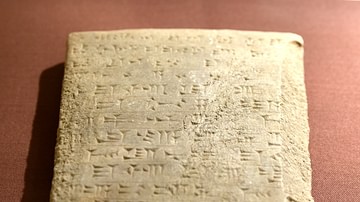
Clay Tablet of Adad-Nirari II from Assur
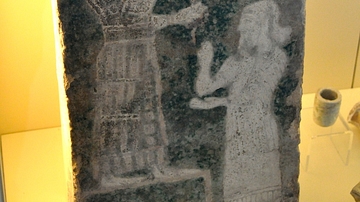
Worship Scene from Assur

Cult Relief of the Mithraic Mysteries
Statue of Assur Bel from Hatra
Cite This Work
APA Style
Amin, O. S. M. (2014, August 28). A Cult Relief from Ashur. World History Encyclopedia. https://www.worldhistory.org/image/2975/a-cult-relief-from-ashur/
Chicago Style
Amin, Osama Shukir Muhammed. "A Cult Relief from Ashur." World History Encyclopedia, August 28, 2014. https://www.worldhistory.org/image/2975/a-cult-relief-from-ashur/.
MLA Style
Amin, Osama Shukir Muhammed. "A Cult Relief from Ashur." World History Encyclopedia, 28 Aug 2014, https://www.worldhistory.org/image/2975/a-cult-relief-from-ashur/.
