


The Rosetta Stone is an incomplete grey and pink granodiorite stela dating from 196 BCE which presents a priestly decree concerning King Ptolemy V of Egypt. The text is in three different versions: Hieroglyphic, Demotic and Greek. The stone was discovered at Port Saint Julien, el-Rashid (Rosetta) on the Nile Delta in Egypt in 1799 CE by Pierre Francois Xavier Bouchard. Thomas Young first identified some of the hieroglyphs related to Ptolemy V but the full text was deciphered by Jean-François Champollion in the early 1820s CE and so the meaning of Egyptian hieroglyphs, lost for 1600 years, was finally re-discovered. (British Museum, London)
Related Images
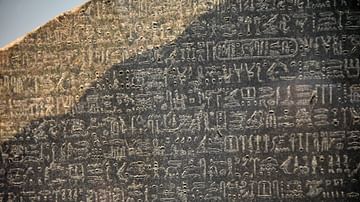
Rosetta Stone Detail, Hieroglyphic Text

Rosetta Stone Detail, Demotic Text

Champollion's notes from the Rosetta Stone

Rosetta Stone, Right Side
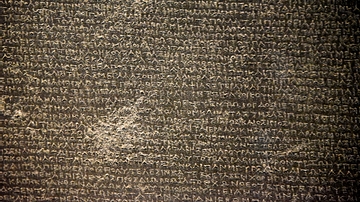
Rosetta Stone Detail, Greek Text

Luwian Hieroglyphs in Hattusa
References
- Rosetta Stone Translation, accessed 1 Dec 2016.
- Rosetta Stone at the British Museum, accessed 1 Dec 2016.
External Links
Cite This Work
APA Style
Museum, T. o. t. B. (2014, January 02). Rosetta Stone. World History Encyclopedia. https://www.worldhistory.org/image/2198/rosetta-stone/
Chicago Style
Museum, Trustees of the British. "Rosetta Stone." World History Encyclopedia, January 02, 2014. https://www.worldhistory.org/image/2198/rosetta-stone/.
MLA Style
Museum, Trustees of the British. "Rosetta Stone." World History Encyclopedia, 02 Jan 2014, https://www.worldhistory.org/image/2198/rosetta-stone/.
