


White marble door of the Hagia Sophia, photograph by Juan Ángel Piqueras, Istanbul, 25 February, 2026.
The Marble Door (also known as “Gate of Heaven and Hell”) in Hagia Sophia’s south upper gallery marks the threshold between the western gallery and the central/eastern bays used for ecclesiastical synods and imperial ceremonies. Crafted from white veined marble with low-relief motifs of fruits, fish, and flowers, it is traditionally interpreted as symbolizing heaven (decorated side) and hell (plainer side), reflecting medieval Byzantine notions of judgment at sacred thresholds. Some scholars date the door to the 6th century CE, contemporary with the church’s construction under Justinian but others place it in the middle Byzantine period, suggesting it was added after the original design.
About the Author
Photo Location
This photograph was taken at the following location:
Related Images
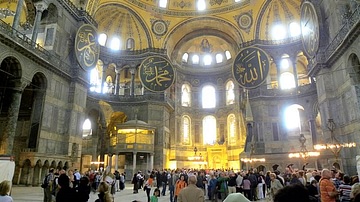
Hagia Sophia, Istanbul
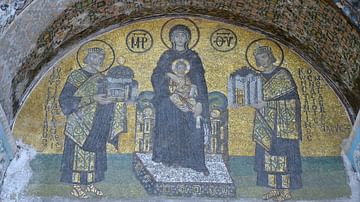
Mosaic with the Virgin Mary, Constantine and Justinian, Hagia Sophia
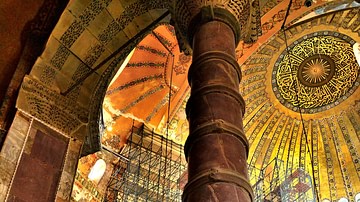
Column of Hagia Sophia
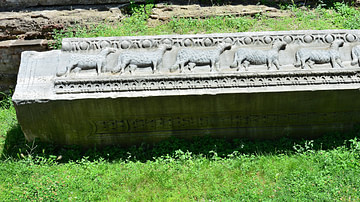
Remnants of Theodosius' Hagia Sophia
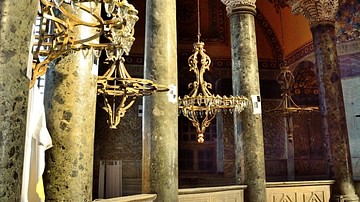
Columns of Hagia Sophia

The Virgin and Child Mosaic, Hagia Sophia
References
- Ali Kılıçkaya. Hagia Sophia and Chora. Silk Road, 2010.
- Hagia Sophia. Müze İstanbul, accessed 15 Mar 2026.
- Kähler, Heinz. Hagia Sophia / by Heinz Kähler ; with a chapter on the mosaics by Cyril Mango.. London : Zwemmer, 1967.
- Mainstone, Rowland J. Hagia Sophia. Thames and Hudson, 2001.
- Marble Door (Hagia Sophia) - Madain Project, accessed 15 Mar 2026.
- Marble Door. Hagia Sophia, accessed 15 Mar 2026.
- Marble Door. South Gallery Doorway of Hagia Sophia, accessed 15 Mar 2026.
- Mert Basım Yayıncılık. The Hagia Sophia. Kariye Museum. 2007
Cite This Work
APA Style
Piqueras, J. Á. (2026, April 02). Marble Door at Hagia Sophia. World History Encyclopedia. https://www.worldhistory.org/image/21630/marble-door-at-hagia-sophia/
Chicago Style
Piqueras, Juan Ángel. "Marble Door at Hagia Sophia." World History Encyclopedia, April 02, 2026. https://www.worldhistory.org/image/21630/marble-door-at-hagia-sophia/.
MLA Style
Piqueras, Juan Ángel. "Marble Door at Hagia Sophia." World History Encyclopedia, 02 Apr 2026, https://www.worldhistory.org/image/21630/marble-door-at-hagia-sophia/.
