


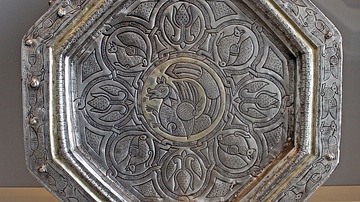
Seven-bowl sweetmeat dish from Iran, 13th to 14th century.
Sweetmeat dishes are notable for their infrequent presence amongst the vast array of Persian ceramic ware. Their history dates back to at least the Seljuk period in the 11th century, when examples of large, round, and solid forms, often divided into compartments, demonstrate the interplay between traditional Persian craftsmanship and broader exchanges with international markets and manufacturers, both in the East and West.
These dishes could be fashioned from a variety of materials, including glazed terracotta, coloured glass, painted porcelain, or a silicon-grained stonepaste commonly referred to as frit. Such items were considered luxurious tableware, reserved for serving an assortment of small sweets and nuts during special occasions.
Of particular interest is the design of the seven-bowl sweetmeat dish. The presence of seven individual compartments may indicate a connection to Naurooz, the Persian New Year, during which it is traditional to present seven blessed edibles collectively known as Haft Seen, or the 'Seven S-words'.
San Diego Museum of Art, California.
About the Author
Related Images
Bronze Axe Head Topped with a Man Ruling Animals from Western Iran
Bronze Horse Bit with Winged Goats from Western Iran

Bronze Figurine with Babylonian Cuneiform Inscription from Western Iran
The Mildenhall Great Dish
Silver Largitio Dish with the Name of Licinius
Sassanian Dish with Simurgh
External Links
Cite This Work
APA Style
Choubineh, N. (2025, September 02). Seven-Bowl Sweetmeat Dish from Iran. World History Encyclopedia. https://www.worldhistory.org/image/20916/seven-bowl-sweetmeat-dish-from-iran/
Chicago Style
Choubineh, Nathalie. "Seven-Bowl Sweetmeat Dish from Iran." World History Encyclopedia, September 02, 2025. https://www.worldhistory.org/image/20916/seven-bowl-sweetmeat-dish-from-iran/.
MLA Style
Choubineh, Nathalie. "Seven-Bowl Sweetmeat Dish from Iran." World History Encyclopedia, 02 Sep 2025, https://www.worldhistory.org/image/20916/seven-bowl-sweetmeat-dish-from-iran/.
