
Celebrate Our Anniversary with Trivia!
Join us on August 23 for a free virtual trivia party featuring questions about ancient civilizations, U.S. history, unusual historical facts, pop culture, and more.

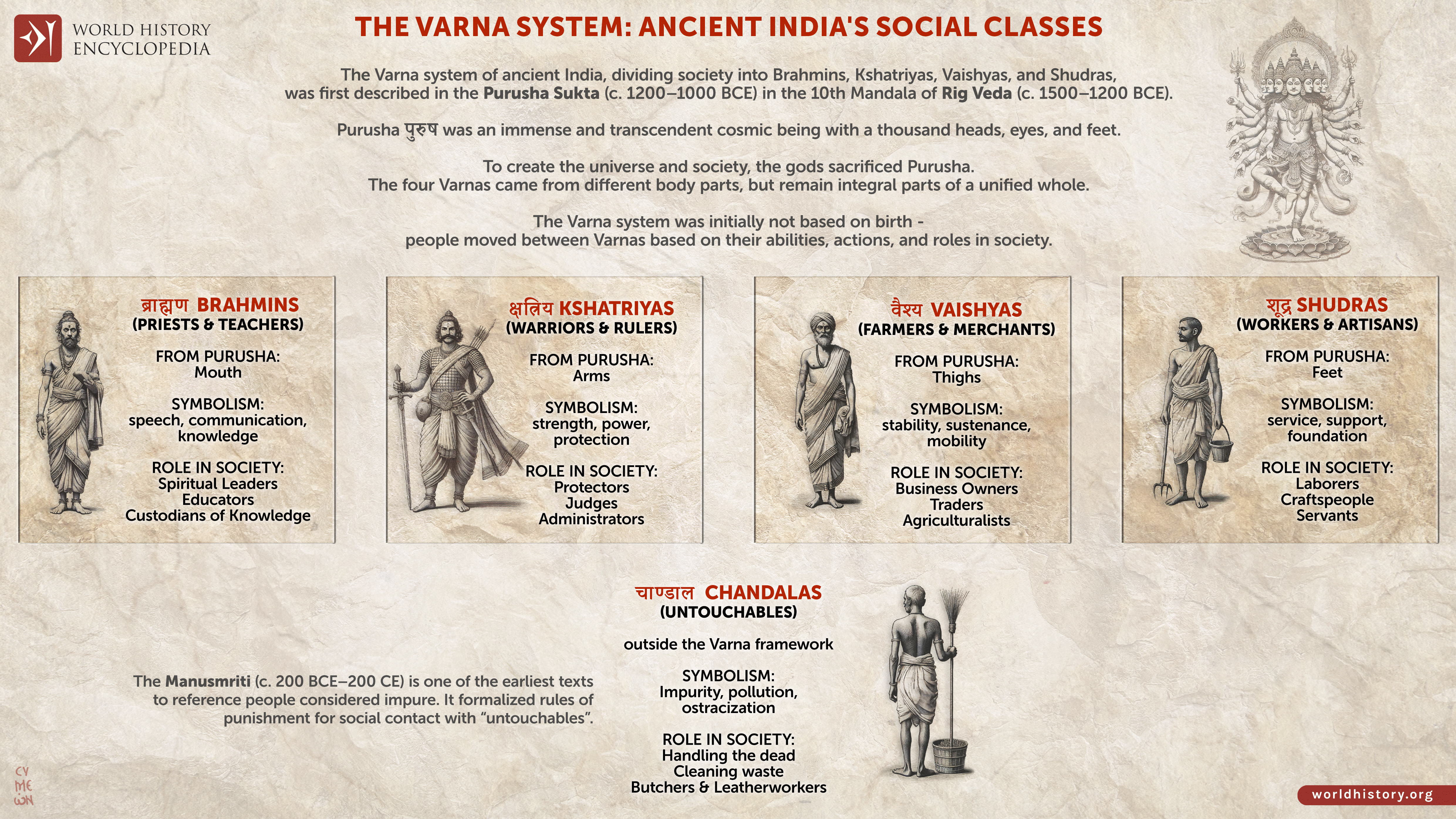
This infographic illustrates the Varna caste system in ancient India. First mentioned in the Rig Veda's Purusha Sukta c. 1200–1000 BCE, it shows society divided into four groups that emerged from the sacrifice of Purusha, a transcendent and immense cosmic being: Brahmins (priests and scholars) from its mouth, Kshatriyas (warriors and rulers) from its arms, Vaishyas (merchants and landowners) from its thighs, and Shudras (laborers and service providers) from its feet. Initially, this system was based on occupation rather than birth. However, it became rigid over time, with varna status inherited. A fifth group, the "Untouchables" (Chandalas), was later added outside of the Varna system, facing severe discrimination and social exclusion.
About the Author
Related Images

The Vedas (Rig-veda)

Roman Baths in Varna

Frigidarium of the Roman Baths in Varna

First Class Entrance on RMS Empress of Ireland

The Dance Class by Degas

A First-Class Stateroom, RMS Titanic
Cite This Work
APA Style
Netchev, S. (2024, September 10). The Four Castes of Ancient India - The Varna System. World History Encyclopedia. https://www.worldhistory.org/image/19424/the-four-castes-of-ancient-india---the-varna-syste/
Chicago Style
Netchev, Simeon. "The Four Castes of Ancient India - The Varna System." World History Encyclopedia, September 10, 2024. https://www.worldhistory.org/image/19424/the-four-castes-of-ancient-india---the-varna-syste/.
MLA Style
Netchev, Simeon. "The Four Castes of Ancient India - The Varna System." World History Encyclopedia, 10 Sep 2024, https://www.worldhistory.org/image/19424/the-four-castes-of-ancient-india---the-varna-syste/.
