


The Warring States period (c. 475–221 BCE) represents the final and most transformative phase of the Eastern Zhou dynasty (770–256 BCE), marked by political fragmentation, sustained interstate warfare, and profound institutional change. As Zhou royal authority weakened, former vassal states asserted full sovereignty, adopting the title of “king” and pursuing territorial expansion through military conquest and diplomatic maneuvering. This era was not merely one of violence but of systemic restructuring: rulers implemented administrative centralization, codified laws, reformed taxation, and strengthened standing armies, accelerating the transition from aristocratic feudal networks to territorial states governed through bureaucratic mechanisms.
By the 4th century BCE, power had consolidated around seven major kingdoms: Qin, Chu, Zhao, Wei, Han, Yan, and Qi, whose rivalry reshaped the political map of northern and central China. The state of Qin, strengthened by Legalist reforms under Shang Yang (4th century BCE), developed a highly centralized and militarized structure that proved decisive. In 221 BCE, King Zheng of Qin (reign 247–221 BCE) completed the conquest of his rivals and proclaimed himself Qin Shi Huang (reign 221–210 BCE), founding the Qin dynasty (221–206 BCE) and inaugurating imperial rule.
About the Author
Related Images

Chu-Han Contention Map
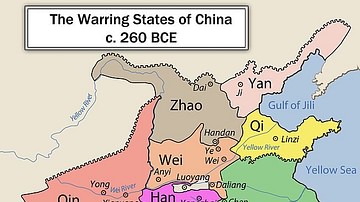
Chinese Warring States, 3rd century BCE

Map of the United States on the Eve of Civil War, 1861
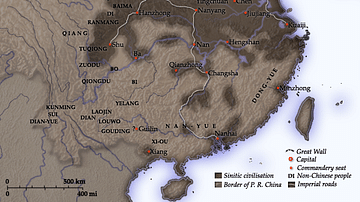
Map of the Qin Empire

Map of Western Zhou

Map of the Ming Dynasty of China, 1368-1644
Cite This Work
APA Style
Netchev, S. (2026, February 17). Map of the Warring States of China & Qin Conquest. World History Encyclopedia. https://www.worldhistory.org/image/16124/map-of-the-warring-states-of-china--qin-conquest/
Chicago Style
Netchev, Simeon. "Map of the Warring States of China & Qin Conquest." World History Encyclopedia, February 17, 2026. https://www.worldhistory.org/image/16124/map-of-the-warring-states-of-china--qin-conquest/.
MLA Style
Netchev, Simeon. "Map of the Warring States of China & Qin Conquest." World History Encyclopedia, 17 Feb 2026, https://www.worldhistory.org/image/16124/map-of-the-warring-states-of-china--qin-conquest/.
