
Celebrate Our Anniversary with Trivia!
Join us on August 23 for a free virtual trivia party featuring questions about ancient civilizations, U.S. history, unusual historical facts, pop culture, and more.


The 1893 Imperial Caucasus Egg by Peter Carl Fabergé (1846-1920). The egg was given by Tsar Alexander III (r. 1881-1894) to his wife Marie Feodorovna. It commemorates their son Grand Duke George Alexandrovich's time in Abastumani in the Caucasus. The egg is made of gold, silver, and platinum with red enamel. There are additional decorations using diamonds, pearls, crystal, and ivory. Four panels open to reveal miniature paintings. Each door has a number which together form '1893'. The egg measures 9.2 cm (3.6 in) in height.
Metropolitan Museum of Art, New York.
License & Copyright
 This image was first published on Flickr. Original image by James Petts. Uploaded by Mark Cartwright, published on 03 May 2021. The copyright holder has published this content under the following license: Creative Commons Attribution-ShareAlike. This license lets others remix, tweak, and build upon a work even for commercial reasons, as long as they credit the author and license their new creations under the identical terms. When republishing on the web a hyperlink back to the original content source URL must be included. Please note that content linked from this page may have different licensing terms.
Related Images
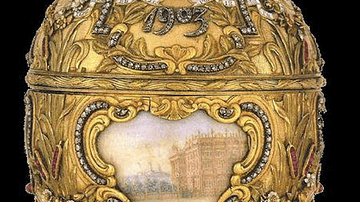
Peter the Great Egg by Fabergé

Imperial Coronation Coach Egg by Fabergé
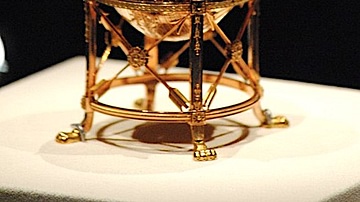
Imperial Pelican Egg by Fabergé
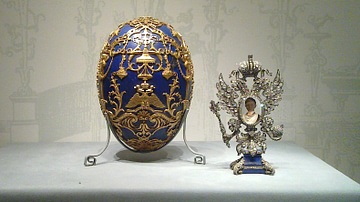
Imperial Tsarevich Egg by Fabergé

Imperial Red Cross Egg by Fabergé

Imperial Napoleonic Egg by Fabergé
Cite This Work
APA Style
Petts, J. (2021, May 03). Imperial Caucasus Egg by Fabergé. World History Encyclopedia. https://www.worldhistory.org/image/13957/imperial-caucasus-egg-by-faberge/
Chicago Style
Petts, James. "Imperial Caucasus Egg by Fabergé." World History Encyclopedia, May 03, 2021. https://www.worldhistory.org/image/13957/imperial-caucasus-egg-by-faberge/.
MLA Style
Petts, James. "Imperial Caucasus Egg by Fabergé." World History Encyclopedia, 03 May 2021, https://www.worldhistory.org/image/13957/imperial-caucasus-egg-by-faberge/.
