
Search
Search Results

Definition
American Civil War - The Birthpangs of the United States
The American Civil War (1861-1865) was the pivotal event in United States history and the largest armed conflict in the Western world following the end of the Napoleonic Wars (1815) and prior to the beginning of the First World War (1914...

Article
William the Conqueror's March on London
William the Conqueror (r. 1066-1087 CE) was victorious at the Battle of Hastings in October 1066 CE, and Harold Godwinson, King Harold II of England (r. Jan - Oct 1066 CE) was dead. The English throne and kingdom were there for the taking...

Image
Sherman's March to the Sea
Sherman's March to the Sea in 1864, part of the American Civil War, original illustration by Felix Octavius Carr Darley and engraved by Alexander Hay Ritchie, c. 1868. Library of Congress, Washington, D.C.

Definition
William Howe
Sir William Howe (1729-1814) was a British military officer and politician, most notable for his role as commander-in-chief of the British army during the initial years of the American Revolutionary War (1775-1783). Despite several significant...

Article
William the Conqueror & the Ely Rebellion
By early 1070 CE William I (r. 1066-1087 CE) had almost completed the Norman conquest of England. There remained threats from the border regions with Wales and Scotland but the north of England had finally be subdued by the ruthless harrying...

Definition
William Still - Father of the Underground Railroad
William Still (1819-1902) was an African American abolitionist known as the "Father of the Underground Railroad" for his efforts in helping to free between 600 to 800 people from slavery. Born the son of formerly enslaved parents, Still devoted...
Image
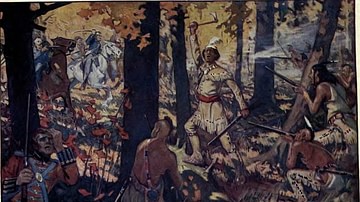
Tecumseh at the Battle of the Thames
Tecumseh leads his Native American warriors into battle for the last time at the Battle of the Thames (5 October 1813). Reproduction of a watercolor by Charles William Jefferys, published in The Story of Tecumseh by N. Gurd, 1912.
Article
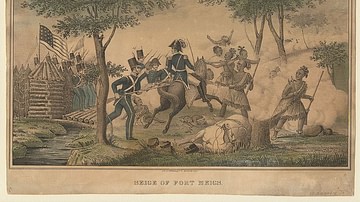
Siege of Fort Meigs
The Siege of Fort Meigs (28 April to 9 May 1813) was a major engagement on the northwestern frontier of the War of 1812. It saw a US army under Major General William Henry Harrison, holed up in the hastily built Fort Meigs, withstand a siege...

Article
Civil War Generals in the Mexican-American War - Friends Who Became Enemies
In 1846, graduates of West Point Military Academy were deployed to fight in the Mexican-American War (1846-1848). Less than 20 years later, many now wearing different uniforms, they would meet again as adversaries in the American Civil War...

Definition
William Wallace
Sir William Wallace (c. 1270-1305) was a Scottish knight and national hero who fought for his country's independence from England. Wallace famously led the Scots to victory against a larger English army at the Battle of Stirling Bridge in...
