
Search
Remove Ads
Advertisement
Search Results

Article
The Isaurians and the End of Germanic Influence in Byzantium
Germanic influence reigned in the Roman Empire from the end of the 4th century CE through the 5th. Germanic individuals took important posts in the government and the military, and Germanic...

Article
Origins of World Agriculture
Agriculture arose independently at several locations across the world, beginning about 12,000 years ago. The first crops and livestock were domesticated in six rather diffuse areas including the Near East, China, Southeast...

Definition
Afrika Korps - Germany's Elite Desert Force
The Deutsches Afrika Korps (DAK) was an elite German armoured unit that fought in North Africa during the Second World War (1939-45). The Korps was initially led by Erwin Rommel (1891-1944) before he was promoted...

Definition
SS Great Britain
The SS Great Britain was a steam-powered ship designed by Isambard Kingdom Brunel (1806-1859) which sailed on its maiden voyage from Liverpool to New York in May 1845. It was the largest passenger ship in the world at the time...

Image
Map of the Travels of Leo Africanus, c. 1509–1518 - Africa, Trade and Empires in the Early 16th Century
The travels of Leo Africanus (al-Hasan ibn Muhammad al-Wazzan al-Fāsī, c. 1494–c. 1554) illuminate the political, commercial, and cultural connections of early...
Definition
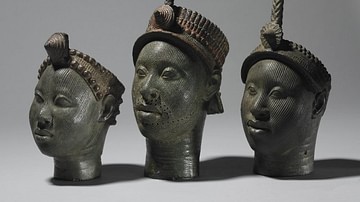
Ife
Ife (aka Ile-Ife) was an ancient African city which flourished between the 11th and 15th century CE in what is today Nigeria in West Africa. Ife was the capital and principal religious centre of the Yoruba kingdom of Ife, which prospered...

Article
German Spring Offensive - Ludendorff's Last Chance to Win WWI
The German Spring Offensive, also called the Ludendorff Offensive after its commander, was the last major German advance of the First World War (1914-18). From March to July 1918, Ludendorff...

Definition
First Crusade
The First Crusade (1095-1102) was a military campaign by western European forces to recapture the city of Jerusalem and the Holy Land from Muslim control. Conceived by Pope Urban II following an appeal from the Byzantine emperor...

Article
What Were the Consequences of WWII?
The consequences of the Second World War (1939-45) were many and varied. Nazi Germany, Fascist Italy, and military-dominated Japan were all defeated. Many occupied countries were liberated and regained their freedom...

Article
1204: The Sack of Constantinople
In 1204 CE the unthinkable happened and Constantinople, after nine centuries of withstanding all comers, was brutally sacked. Even more startling was the fact that the perpetrators were not any of the traditional...
