
Search
Remove Ads
Advertisement
Search Results
Image
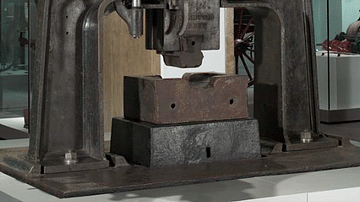
Royal Mint Steam Hammer
A Royal Mint steam hammer, a device invented by James Nasmyth (1808-1890) in 1839 during the Industrial Revolution. (The Science Museum, London)
Image
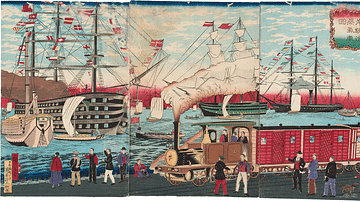
A Steam Locomotive in Yokohama, 1874
View of a steam locomotive on the coast of Yokohama at the time of the opening of Yokohama station, drawing by Utagawa Hiroshige III, 1874.
Hessische Kulturstiftung.

Definition
Skara Brae
Skara Brae is a Neolithic Age site, consisting of ten stone structures, near the Bay of Skaill, Orkney, Scotland. Today the village is situated by the shore but when it was inhabited (c.3100-2500 BCE) it would have been further inland. Steady...
Definition
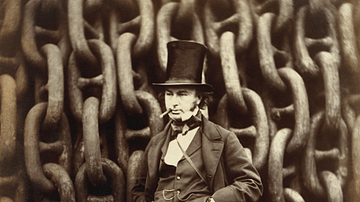
Isambard Kingdom Brunel
Isambard Kingdom Brunel (1806-1859) was a British engineer and a key figure of the British Industrial Revolution (1760-1840). Brunel masterminded the Great Western Railway from London to Bristol, designed and built innovative giant steamships...

Article
The Textile Industry in the British Industrial Revolution
During the Industrial Revolution (1760-1840), textile production was transformed from a cottage industry to a highly mechanised one where workers were present only to make sure the carding, spinning, and weaving machines never stopped. Driven...

Video
Coal, Steam, & The Industrial Revolution: Crash Course
In which John Green wraps up revolutions month with what is arguably the most revolutionary of modern revolutions, the Industrial Revolution. While very few leaders were beheaded in the course of this one, it changed the lives of more people...

Image
The First Industrial Revolution, c. 1760 - 1840
The First Industrial Revolution refers to the profound economic and technological transformation that reshaped parts of Europe and North America between c. 1760 and 1840, first and most intensively in Britain under monarchs such as George...

Definition
Luddite
The Luddites, named after their legendary leader Ned Ludd, were workers who protested at the mechanization of the textile industry during the Industrial Revolution. From 1811 to 1816, the violent strategy of the Luddites was to smash the...

Article
Why the Industrial Revolution Started in Britain
The Industrial Revolution saw a wave of technological and social changes in many countries of the world in the 18th and 19th centuries, but it began in Britain for a number of specific reasons. Britain had cheap energy with its abundant supply...

Definition
Edo Period
The Edo period refers to the years from 1603 until 1868 when the Tokugawa family ruled Japan. The era is named after the city of Edo, modern-day Tokyo, where the Tokugawa shogunate had its government. It is also sometimes referred to as the...
