
Search
Remove Ads
Advertisement
Search Results
Image
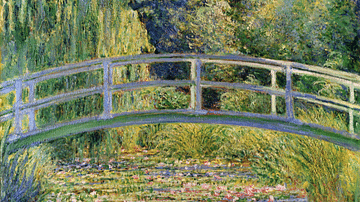
Water Lily Pond by Monet
A c. 1899 oil on canvas, Water Lily Pond, by Claude Monet (1840-1926), the French impressionist painter. The Japanese garden with bridge and lily pond was purpose-built by the artist at his Giverny home, and he spent the...
Image
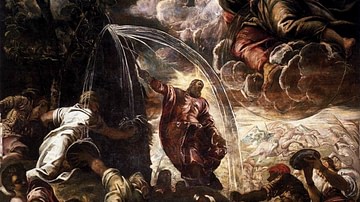
Moses Drawing Water from the Rock by Tintoretto
The oil painting Moses Drawing Water from the Rock by the Italian Renaissance artist Tintoretto (c. 1518-1594 CE). c. 1577 CE. (Scuola Grande di San Rocco, Venice)
Image
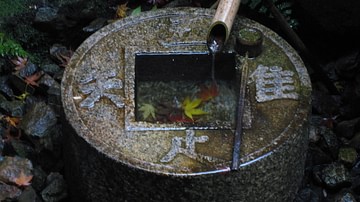
Water Basin, Ryoanji
A water basin in the form of a Chinese coin, Ryoanji temple, Kyoto, Japan. The Zen Buddhist temple was first built in the 15th century CE. The basin's inscription translates as ‘Learn only satisfaction’, meaning learning should...
Image
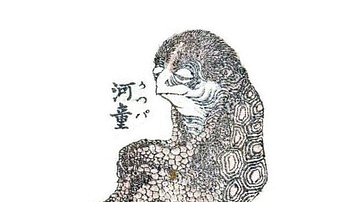
Hokusai's Kappa, a Japanese Water Sprite
A drawing of a kappa, a Japanese mythological water sprite, by Katsushika Hokusai (1760-1849) as part of his wider work, the Hokusai Manga, which he began publishing in 1812.
Image
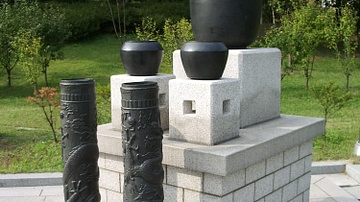
Sejong-era Water Clock Replica
Replica of a water-powered clock invented in 1433 CE by the royal scholars under the guidance of King Sejong the Great (r. 1418-1450 CE).
Yeouido Park, Seoul, South Korea.
Image
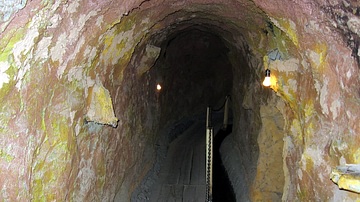
Turfan Water System Underground Channel
The underground channel of a qanat in the Turfan water system in the Turpan Depression of Xinjiang, China.
Image
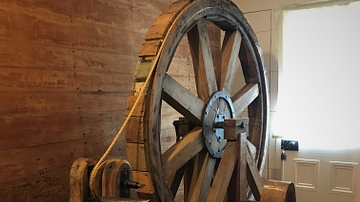
Water-Powered Mill
This is the first water-powered mill to be built in New Zealand in 1834 CE at the Te Waimate Mission, Bay of Islands. This photo was taken in November 2019.
Image
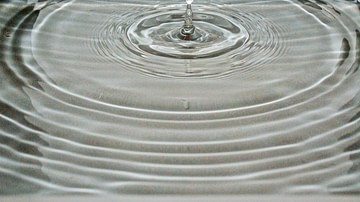
A Drop of Water (Atman)
In The Upanishads, the connection between Atman and Brahman is spiritual. When moksha or liberation is achieved, Atman returns to the Brahman, to the source, like a drop of water returning to the ocean.
Image
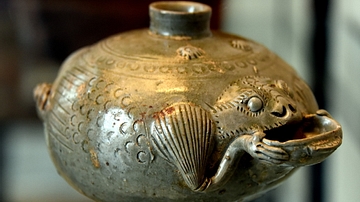
Yue Ware Water Vessel
Yue stoneware water-dropper vessel in the form of a frog or a toad holding an ear or wine cup. Glazed. Made in Shanglinhu. From Zhejiang province. South China. Western Jin Dynasty. 265-316 CE. (The British Museum, London).
Image
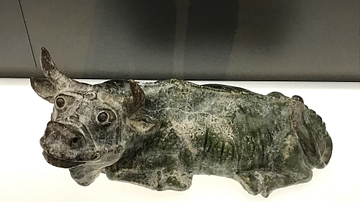
Ancient Chinese Water Buffalo Figure
This figurine of a reclining water buffalo comes from northern China. It was created during the period of the Eastern Han Dynasty, c. 2nd-3rd centuries CE. (Museum Rietberg, Zürich).
