
Search
Remove Ads
Advertisement
Search Results
Image
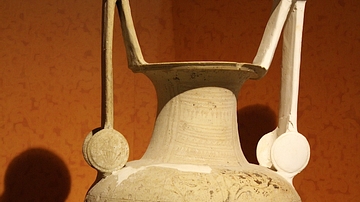
Messapian Trozella Vase, Valesio
The two-handled pottery vessel (trozella) which was unique to the Messappian culture of southern Italy. This version dates to the 4th century BCE and was probably used for funerary purposes. From Valesio near Brundisum...
Image
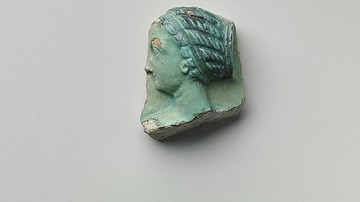
Faience Glass Vase Portraying Arsinöe II
This fragment of blue faience glass came from a kind of libation vessel known as "oinochoai" which were used in festivals honouring the deified Ptolemaic queens. The figure portrayed is Arsinöe II who wears...
Image
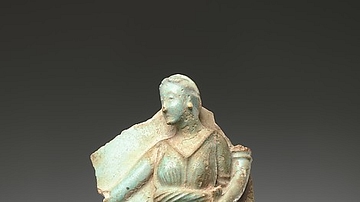
Vase Fragment Portraying Berenike II as Isis-Aphrodite
This fragment came from a wine jug (referred to as "oinochoai") that was used for pouring libations during festivals of the Ptolemaic dynastic cult. This particular jug was crafted around 246-221...

Image
Hermes, Knidos Vase
An oinophoros from Knidos, Greece depicting Hermes. 2nd century CE. (Pushkin Museum, Moscow)
Image
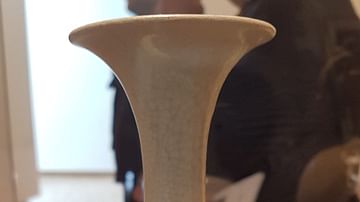
Tang Dynasty Vase
C. 600-634 CE. Porcelain. 25 cm (height). Excavated from the tomb of Princess Fengning (583-610 CE) and her husband Wei Yuanzhao (572-623 CE), Shaolingyuan, Chang'an District, Xi'an, 1990. From the Shaanxi Provincial Institute...
Image
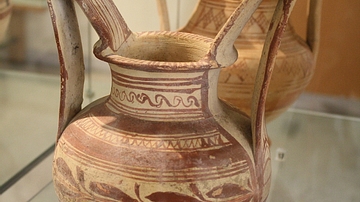
Two-handled Vase, Brundisium
The two-handled pottery vessel (trozella) which was unique to the Messappian culture of southern Italy. 5th century BCE, Brundisum, southern Italy. (Archaeological Museum of Brindisi, Italy)
Image
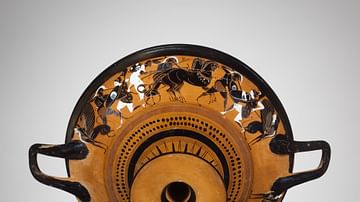
Black-Figure Vase with Amazons
This black-figure vessel portrays Amazon warriors and Greeks battling each other. Attributed to the Group of Rhodes, c. 540 BCE. Black-figure pottery. 12.9 x 25.4 cm (5 1/16 x 10 in). (Metropolitan Museum of Art)
Image
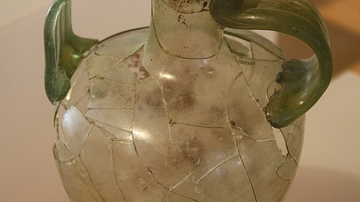
Roman Two-Handled Glass Vase
A Roman two-handled glass vessel. 4th century CE, from the Necropolis de l'Avinguda de la Constitucio, Valencia. (Archaeological Museum, Valencia, Spain)

Video
Greek vase, animated
Animation par morphing d'une scène de douche sur un vase grec. Morphing-based animation of a shower scene on a greek vase. Ce travail est intégré dans le film "Le parfum retrouvé" (Réalisation Luc Ronat, CNRS Images 2012...

Definition
Black Figure Pottery
Black figure pottery is a type of Greek pottery named after the colour of the scenes painted on vessels. It was first produced in Corinth c. 700 BCE and then adopted by pottery painters in Attica, where it would become the...
