
Search
Remove Ads
Advertisement
Search Results

Article
Ancient Roman Society
Rome began as a small city on the banks of the Tiber River in Italy. The Latin tribes (also known as the Latini or Latians) inhabited the region c. 1000 BCE but the founding of the city is dated to 753 BCE. The family was...

Article
The Propaganda of Octavian and Mark Antony's Civil War
Propaganda played an important role in Octavian (l. 63 BCE - 14 CE) and Mark Antony's (l. 83 – 30 BCE) civil war, and once victorious at the Battle of Actium (31 BCE), Octavian returned home to become...

Article
Roman Household Spirits: Manes, Panes and Lares
To the ancient Romans, everything was imbued with a divine spirit (numen, plural: numina) which gave it life. Even supposedly inanimate objects like rocks and trees possessed a numen, a belief which no...

Article
Ten Ancient Rome Facts You Need to Know
Ancient Roman culture affected vast numbers of people across the known world of its time, beginning with the rise of the Roman Republic (509-27 BCE) and throughout the duration of the Roman Empire (27 BCE -...

Article
Elizabeth I & the Power of Image
Aware of the power of appearances, Elizabeth I of England (r. 1558-1603 CE) carefully controlled her image throughout her reign and through costume, hair, jewellery, and art, she presented herself as the great Virgin...

Article
Roman Women in Business
Roman women faced legal, ideological, and cultural limitations in several areas of their lives; deep-rooted traditions regarding the role of women in the Roman world resulted in pre-conceived views which saw women characterised...

Article
The Battle of Actium: Birth of an Empire
The battle of Cynoscephalae in 197 BCE concluded the Second Macedonian War (200-197 BCE) and consolidated Rome's power in the Mediterranean, finally resulting in Greece becoming a province of Rome in 146 BCE...
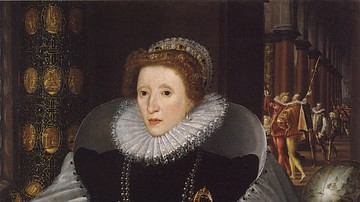
Image
Elizabeth I Sieve Portrait
A 1579-83 CE portrait by Quentin Metsys the Younger of Elizabeth I of England (r. 1588-1603 CE). It is known as the 'Sieve Portrait' because the queen holds a large sieve in her left hand which is a traditional symbol...

Video
Livia Drusilla the First Empress of the Roman Empire
Livia Drusilla was the third wife of Augustus Caesar, and the first Empress of the Roman Empire. She lived with Augustus in a house on Palatine Hill, and she was known as Romana princips, kind of...

Video
The Myth of Echo and Narcissus
Narcissus is a figure from Greek mythology who was so impossibly handsome that he fell in love with his own image reflected in a pool of water. Even the lovely nymph Echo could not manage to tempt him from his self-absorption...
