
Search
Search Results
Image
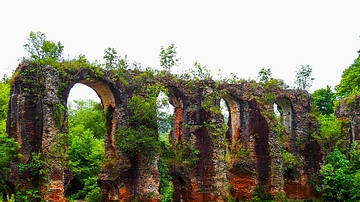
Roman Aqueduct of Nicopolis
The Roman aqueduct at Nicopolis in Epirus, Italy. Nicopolis was founded in 29 BCE by Augustus (r. 27 BCE - 14 CE), and is notable for being the home of the philosopher Epictetus (c. 50 CE - c. 130 CE) after his exile by Domitian (r. 81 -...

Image
The Arceuil Aqueduct by Guillaumin
A c. 1874 oil on canvas, The Arceuil Aqueduct at Sceaux Railroad Crossing, by Armand Guillaumin (1841-1927), the French impressionist painter. The impressionists were eager to show the new industrial architecture of the age, such as railway...

Video
Pont du Gard (Roman Aqueduct) (UNESCO/NHK)
The Pont du Gard was built shortly before the Christian era to allow the aqueduct of Nîmes, France (which is almost 50 km long) to cross the Gard river. The Roman architects and hydraulic engineers who designed this bridge, which stands almost...

Video
Old Town of Segovia and its Aqueduct (UNESCO/NHK)
The Roman aqueduct of Segovia, probably built c. A.D. 50, is remarkably well preserved. This impressive construction, with its two tiers of arches, forms part of the setting of the magnificent historic city of Segovia. Other important monuments...

Definition
Basil the Great
Saint Basil (c. 330 - c. 379 CE), also known as Basil the Great and Basil of Caesarea, was a bishop of Caesarea in central Asia Minor who staunchly defended the church against the 4th-century CE heresy of Arianism. Basil's writings on monasticism...

Article
Caesarea Maritima's Role in the Roman Empire
Caesarea Maritima, the city Herod the Great (r. 37-4 BCE) built for Rome on the southeastern coast of the Mediterranean served as the Roman Empire's powerbase of operations both commercially and militarily. With Rome's ultimate goal of adding...
Article
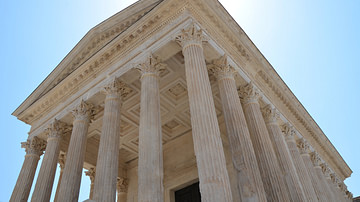
Top 10 Archaeological Sites in Provence
Provence has inherited a rich legacy from antiquity, boasting some of the best-preserved Roman ruins in Europe. In the 2nd century BCE, the Romans began their conquest of the region and called it “Provincia Romana,” giving us the region's...

Article
Fall of the Western Roman Empire
To many historians, the fall of the Western Roman Empire in the 5th century CE has always been viewed as the end of the ancient world and the onset of the Middle Ages, often improperly called the Dark Ages, despite Petrarch's assertion. Since...

Article
Roman Mills
The Romans constructed mills for use in agriculture, mining and construction. Around the 3rd century BCE, the first mills were used to grind grain. Later developments and breakthroughs in milling technology expanded their use to crushing...

Article
Sack of Rome 410 CE
In August of 410 CE Alaric the Gothic king accomplished something that had not been done in over eight centuries: he and his army entered the gates of imperial Rome and sacked the city. Although the city and, for a time, the Roman Empire...
