
Search
Remove Ads
Advertisement
Search Results

Definition
Roman Auxiliary Cavalry
The Roman army consisted of three separate divisions: the famed legions, the cavalry, and lastly, the auxiliaries. The auxiliaries (auxilia) were comprised of infantry cohorts, mounted infantry, and cavalry units or wings...
Image
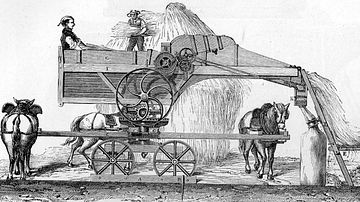
Horse-Powered Threshing Machine
A French illustration of a horse-powered threshing machine. This machine, used to separate grain from the husk, was invented in 1787 by the Scotsman Andrew Meikle (1719-1811). The machine used a drum with beaters to...

Image
Stanwick Horse Mask
The Stanwick Horse Mask is Celtic bronze horse head mask which was discovered as part of the Stanwick Hoard of North Yorkshire, England. The piece is concave and has side brackets to attach it to another object, perhaps an...

Image
Lakota Chief Red Horse
Red Horse (l. 1822-1907), Miniconjou Lakota Sioux chief. Commercial cabinet card published by D. F. Barry (1854-1934). Red Horse's account of the Battle of the Little Bighorn and his accompanying ledger art are among the...
Image
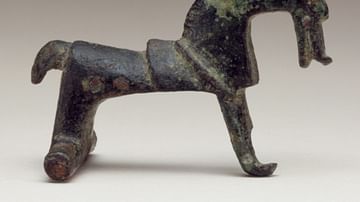
Celtic Horse Brooch
This small bronze brooch was made in Central Europe sometime between 650 and 550 BCE. This horse-shaped pin is one of many examples of Celtic animal brooches from Central Europe. From the Metropolitan Museum of Art, New York...
Image
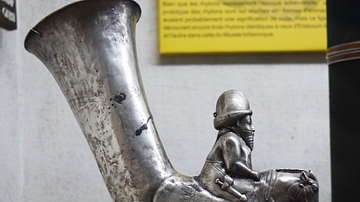
Horse Rider Rhyton
This horse rider ryhton was discovered while archaeologists excavated the ancient Erebuni Fortress, which is located in present-day Yerevan, Armenia. It dates from the 5th century BCE when Erebuni was under Persian control and...

Image
Celtic Coin Depicting Horse & Rider
The reverse of a 2nd Century - 1st Century BCE Celtic silver coin from Central Europe, specifically what is now the Czech Republic. The reverse of this coin depicts a horse and rider in stylized geometric forms...

Image
Celtic Coin with Abstract Horse
Celtic coin from modern-day Romania, 3rd- 2nd century BCE. The reverse depicts a horse and helmeted rider while the obverse depicts the head of Zeus, it is one of many imitations of Greek currency to be minted in...
Image
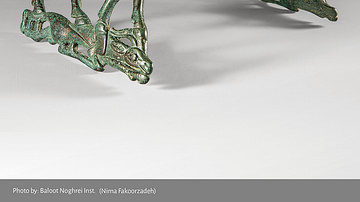
Bronze Horse Bit with Winged Goats from Western Iran
Luristan Bronze artefact from Iron Age II or III, c. 950-650 BCE. National Museum of Iran, Tehran. Acc. no. 3915, Photograph by Nima Fakourzadeh (Baloot Noghrei) In archaeology, the cast objects...
Image
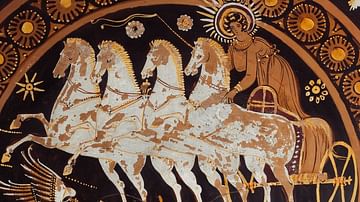
Eos in Her Four-horse Chariot
Eos in her four-horse chariot, detail of terracotta red-figure lekanis vase attributed to the Stuttgart group, from Canosa, late 300s BCE.
Metropolitan Museum of Art, New York.
