
Search
Remove Ads
Advertisement
Search Results

Definition
Artemis
Artemis was the Greek goddess of hunting, wild nature, and chastity. Daughter of Zeus and sister of Apollo, Artemis was a patron of girls and young women, and a protectress during childbirth. Artemis was widely worshipped but her most...

Definition
Vulcan
Vulcan or Volcanus was the Roman god of fire and forge, the equivalent of Hephaestus from Greek mythology. The son of Jupiter and Juno, he was the special patron of blacksmiths and artisans. As the god of the forge and the devastating...
Definition
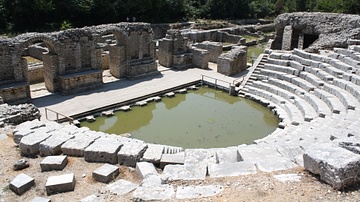
Butrint
Butrint (ancient name Buthrotum) is located on the fertile coast of Epirus in present-day Albania and was an important settlement in Hellenistic and Roman times due to its position on the route from Italy to mainland Greece down the...

Definition
Siren - The Woman-Bird Creatures of Greek Mythology
Sirens were creatures from Greek mythology that enticed sailors to their destruction with their irresistibly beautiful singing. The most famous appearance of sirens in literature is in Homer's Odyssey...

Definition
Franks
The Franks were a Germanic people who originated along the lower Rhine River. They moved into Gaul during the Migration Age, where they established one of the largest and most powerful kingdoms in Europe after the fall of the Western...

Definition
Oenone
Oenone was a nymph in Greek Mythology, the daughter of the river god Cebren and sister of the nymph Asterope/Hesperia. She was given the gift of prophecy by Rhea (mother of the gods) and the gift of healing by Apollo. Her name comes from...

Definition
Themis
Themis is the personification and goddess of divine law, will, and justice in Greek mythology. She was held in high esteem by the Olympians, often sitting by Zeus' throne and giving him wise counsel. Themis held the place of Oracle at...

Definition
Ancient Rome
According to legend, Ancient Rome was founded by the two brothers, and demigods, Romulus and Remus, on 21 April 753 BCE. The legend claims that in an argument over who would rule the city (or, in another version, where the city would...
Definition
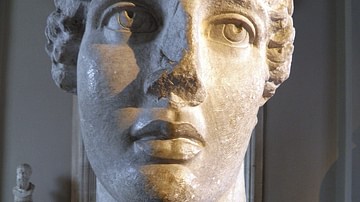
Lesbos
Lesbos, a Greek island located in the eastern Aegean, had several prosperous city-states which thrived from the Bronze Age to the Byzantine era. Switching many times between independence, Persian and Greek control, Lesbos was often a...

Definition
The Eumenides
The Eumenides is a play written by Aeschylus (c 525 – 455 BCE), the “Father of Greek Tragedy,” the most popular and influential of all tragedians of his era. The Eumenides was the third play of a trilogy, The Oresteia, with the...
