
Search
Remove Ads
Advertisement
Search Results

Image
Theatre of Dionysos Eleuthereus, Athens
The 4th century stone version of the Theatre of Dionysos Eleuthereus, on the slopes of the acropolis of Athens. The theatre was orginally constructed in the 6th century BCE.

Image
Seating of the Theatre of Epidaurus
The theatre of Epidaurus was first built in the 4th century BCE and is possibly the best preserved ancient Greek theatre. Extensions were made in the 2nd century BCE taking its capacity to 12,000.

Image
Aeschylus
Portrait of the Athenian tragedian Aeschylus, Roman copy of a Greek original from the 4th century BCE, from Italy (Neues Museum, Berlin).

Image
Euripides
A bust of Greek Tragedian Euripides (c. 484-407 BCE). Roman copy of a 4th century BCE Greek original. (Vatican Museums, Rome)
Image
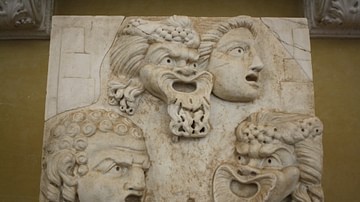
Theatre Masks
A marble relief depicting theatre masks as worn by actors in both Greek and Roman tragedies and comedies. 2nd century CE (Vatican Museums, Rome).
Image
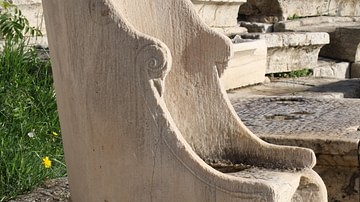
Seat from the Theatre of Dionysos, Athens
One of the special front seats from the Theatre of Dionysos, on the slopes of the acropolis of Athens. Second half of the 4th century BCE. The theatre was orginally constructed in the 6th century BCE.

Definition
Ancient Greek Religion
In the ancient Greek world, religion was personal, direct, and present in all areas of life. With formal rituals which included animal sacrifices and libations, myths to explain the origins of mankind and give the gods a human face, temples...

Definition
Athens
Athens, Greece, with its famous Acropolis, has come to symbolize the whole of the country in the popular imagination, and not without cause. It not only has its iconic ruins and the famous port of Piraeus but, thanks to ancient writers, its...

Definition
Charlemagne
Charlemagne (Charles the Great, also known as Charles I, l. 742-814) was King of the Franks (r. 768-814), King of the Franks and Lombards (r. 774-814), and Holy Roman Emperor (r. 800-814). He is among the best-known and most influential figures...

Definition
Homer
Homer (c. 750 BCE) is perhaps the greatest of all epic poets and his legendary status was well established by the time of Classical Athens. He composed (not wrote, since the poems were created and transmitted orally, they were not written...
