
Search
Did you mean: Tegea?
Remove Ads
Advertisement
Search Results

Definition
Lucius Verus
Lucius Verus was Roman emperor from 161 to 169 CE. Lucius Verus was Marcus Aurelius' adopted brother and co-emperor, a man whose time on the throne is overshadowed by the reign of the last of the Five Good Emperors. In the final...

Definition
Heka
Heka is the god of magic and medicine in ancient Egypt and is also the personification of magic itself. He is probably the most important god in Egyptian mythology but is often overlooked because his presence was so pervasive as to make...

Definition
Mitanni
The Kingdom of Mitanni, known to the people of the land, and the Assyrians, as Hanigalbat and to the Egyptians as Naharin and Metani, once stretched from present-day northern Iraq, down through Syria and into Turkey and was among the...

Definition
Edda
Edda is a term used to describe two Icelandic manuscripts that were copied down and compiled in the 13th century CE. Together they are the main sources of Norse mythology and skaldic poetry that relate the religion, cosmogony, and history...

Definition
Thugga
Thugga (also Dougga) was a town in North Africa which was first a Numidian and then a Carthaginian settlement before being incorporated into the Roman Empire. The town was built on a strategically favourable limestone hilltop overlooking...
Definition
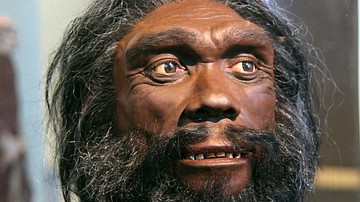
Homo Heidelbergensis
Homo heidelbergensis is an extinct species of human that is identified in both Africa and western Eurasia from roughly 700,000 years ago onwards until around 200,000 years ago – fitting snugly within the Middle Pleistocene...

Definition
Apollo
Apollo was a Greek god associated with the bow, music, and divination. The epitome of youth and beauty, source of life and healing, patron of the arts, and as bright and powerful as the sun itself, Apollo was perhaps the most loved of...

Definition
Shinto Architecture
The architecture of the 80,000 Shinto shrines in Japan varies depending on geographical location, the deity worshipped, and the date of foundation. The earlier Shinto shrines tend to be simpler and less decorative affairs than...

Definition
Ashoka the Great
Ashoka the Great (r. 268-232 BCE) was the third king of the Mauryan Empire (322-185 BCE) best known for his renunciation of war, development of the concept of dhamma (pious social conduct), and promotion of Buddhism as well as...

Definition
Uluburun Shipwreck
The Uluburun shipwreck is a Bronze Age vessel discovered lying off the coast of Kas, Turkey. The ship, probably originally from Phoenicia/Canaan, dates to between 1330 and 1300 BCE and was carrying a full cargo of trade goods...
