
Search
Remove Ads
Advertisement
Search Results

Image
Three Venus Statues
Three marble sculptures of “Venus” (left to right): Venus of Arles (194 cm, ca. late 1st cent. BCE; Louvre inv. no. Ma 439), proper right arm and lower left arm are modern restorations; Venus of Milos (202 cm, 100-50 BCE; Louvre...

Image
Three-Headed Demon
Etruscan three-headed Demon from a pediment relief found in Orvieto (Italy). Dated to around 480 BCE.
Altes Museum, Berlin.

Video
House Altar Depicting Akhenaten, Nefertiti and Three Daughters
More free lessons at: http://www.khanacademy.org/video?v=ryycDVWXDvc House Altar depicting Akhenaten, Nefertiti and Three of their Daughters, limestone, New Kingdom, Amarna period, 18th dynasty...

Video
Why Were There Three Popes at the Same Time? - Joelle Rollo-Koster
Dig into the history of the Papal Schism, which caused a split in the Catholic Church while 3 popes vied for supremacy. For almost two millennia, the Pope has been a figure of supreme...

Image
Three Doctors Attend a Man with the Plague
Woodcutting of a plague-stricken man lying in bed, attended by three physicians. From the Pestbuch, a 16th Century CE medical treatise by Hieronymous Brunschwig (c. 1450-1512 CE). (Courtesy of the Historical...

Image
Three Exedras Building, Hadrian's Villa
View of one of the gardens of the Three Exedras building at Hadrian's Villa in Tivoli (Italy). The building was a semicircular arcaded triclinium (dining room) with a large, rectangular fountain located to the...
Image
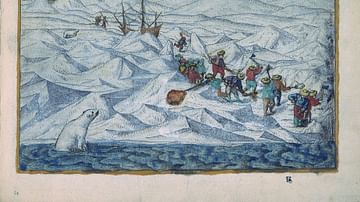
A Depiction of Willem Barentsz's Three Voyages
A Depiction of Willem Barentsz's three expeditions in search of the coveted Northeast Passage to Cathay (China) and the Spice Islands. Woodcut. 1598.

Image
The Three Moirai
The Three Moirai, relief, grave of Alexander von der Mark by Johann Gottfried Schadow.
Alte Nationalgalerie, Berlin.

Image
Three Hellenistic Heads, Cyprus
Three heads of worshippers from the Temple of Apollo-Reshef, Cyprus, 350-250 BCE. Early Hellenistic style. (British Museum, London)

Definition
Chlothar I
Chlothar I (l. c. 498-561) was a Merovingian king of the Franks, the second to rule over a unified Frankish kingdom after his father, Clovis I (l. c. 466-511). When Clovis died in 511, his kingdom was divided up between his four sons...
