
Search
Remove Ads
Advertisement
Search Results
Definition
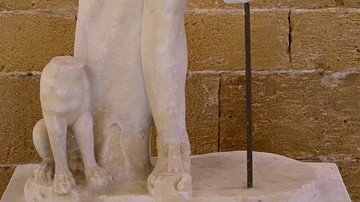
Britomartis
Britomartis, also known as Diktynna (Dictynna), was the Cretan goddess of hunting and fishing nets in Greek mythology. Although referred to as a nymph and worshipped locally, she had at least two significant and active shrines, one...
Definition
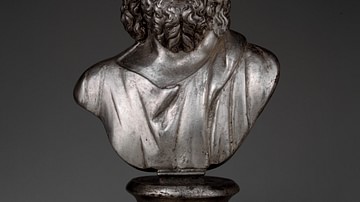
Serapis
Serapis is a Graeco-Egyptian god of the Ptolemaic Period (323-30 BCE) of Egypt developed by the monarch Ptolemy I Soter (r. 305-282 BCE) as part of his vision to unite his Egyptian and Greek subjects. Serapis’ cult later spread throughout...

Definition
Mythology
Myths are a part of every culture in the world and are used to explain natural phenomena, where a people came from and how their civilization developed, and why things happen as they do. At their most basic level, myths comfort by...

Definition
Dodekaschoinos
The Dodekaschoinos (literally "Twelve Cities" in Greek) was the name of a region in Lower Nubia that became an important province of the Ptolemaic Kingdom after it was annexed from Meroitic Nubia by the Egyptian kingdom. The area...

Definition
Roman Army
The Roman army, famed for its discipline, organisation, and innovation in both weapons and tactics, allowed Rome to build and defend a huge empire which for centuries would dominate the Mediterranean world and beyond. Overview...

Definition
Persepolis
Persepolis was the capital of the Persian Achaemenid Empire from the reign of Darius I (the Great, r. 522-486 BCE) until its destruction in 330 BCE. Its name comes from the Greek Perses-polis (Persian City), but the Persians knew...

Definition
Ptolemaic Dynasty
The Ptolemaic dynasty was a Macedonian royal family that ruled Ptolemaic Egypt from 323 to 30 BCE. It was founded by Ptolemy I, a general and successor of Alexander the Great. They built Alexandria, including the Lighthouse of...

Definition
Noah's Ark
Noah’s Ark is the boat that saved a generation of humans and animals when the God of Israel decided to destroy the human race by sending a great flood upon the earth. The story shares many elements with ancient, neighboring civilizations...

Article
Cleopatra & Antony
Regarded by the Romans as "fatale monstrum" – a fatal omen – Cleopatra is one of the ancient world's most popular, though elusive figures. The Egyptian queen has been immortalized by numerous writers and filmmakers, most popularly...

Article
Wine Culture in the Hellenistic Mediterranean
The culture of drinking wine was enjoyed throughout the Mediterranean world, and what is true now was true in antiquity, too: wine is always good business. The Hellenistic Period (c. 335-30 BCE), between...
