
Search
Remove Ads
Advertisement
Search Results

Article
Letters & Post in the Ancient World
Letters and their delivery via a state communication system was a feature of many ancient cultures. The writing medium may have differed but the Mesopotamians, Egyptians, Greeks, Romans, and Incas all had the means...

Article
Libraries in the Ancient World
Libraries were a feature of larger cities across the ancient world with famous examples being those at Alexandria, Athens, Constantinople, Ephesus, and Nineveh. Rarely ever lending libraries, they were typically designed...

Article
Warrior Women of the World of Ancient Macedon
The 8th November is celebrated as Archangels Day in Greece, but on that November day in 1977 CE something remarkable happened: an excavation team led by Professor Manolis Andronikos were roped down into...
Article
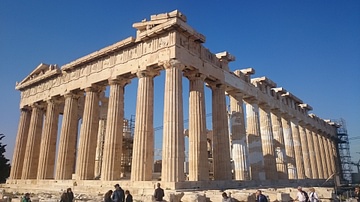
Greek World Heritage Sites
Greece, the 'cradle of western civilization', is home to a large number of spectacular sites from the ancient world, several of which have been placed on the UNESCO World Heritage List. These sites of great historical...

Article
Genocide in the Ancient World
Genocide is often viewed as a particular feature of our own current age. This perception largely stems from the terrible events which took place during World War Two in the 20th century CE in the parts of Europe occupied...

Definition
Hellenic World
The Hellenic World' is a term which refers to that period of ancient Greek history between 507 BCE (the date of the first democracy in Athens) and 323 BCE (the death of Alexander the Great). This period is also referred to as...

Image
The Seven Lucky Gods of Japan - Seven Deities, Countless Blessings
The Seven Lucky Gods of Japan (Shichifukujin) are a group of deities associated with prosperity, happiness, and longevity. Blending Shinto, Buddhist, Taoist, and even Hindu influences, they...

Definition
Ancient Egypt - The Land of the Gods of Balance and Harmony
Egypt is a country in North Africa, on the Mediterranean Sea, and is home to one of the oldest civilizations on Earth. The name "Egypt" comes from the Greek Aegyptos, which was the Greek pronunciation...
Image
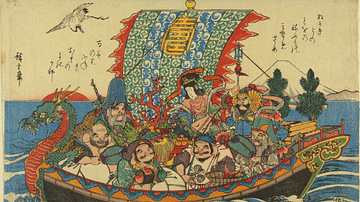
Seven Lucky Gods on Takarabune
The Seven Lucky Gods (aka Shichifukujin) of Japanese folklore on their treasure ship or takarabune. By Hiroshige (1797-1858 CE). Woodblock print, c. 1840 CE. (Victoria & Albert Museum, London)
Image
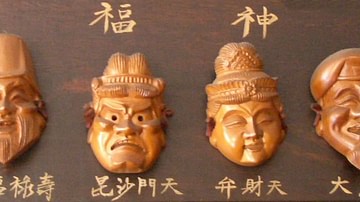
Seven Lucky Gods
The Seven Lucky Gods or Shichifukujin of Japanese folklore. From left to right: Soldan Sağa Hotei, Juroujin, Fukurokuju, Bishamonten, Benzaiten, Daikokuten, Ebisu
