
Search
Remove Ads
Advertisement
Search Results
Image
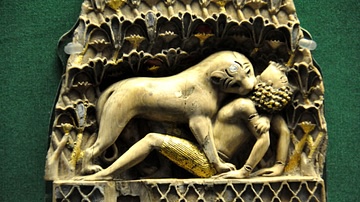
Lioness Devouring a Boy, Phoenician Ivory Panel
This Phoenician carved ivory panel is one of an almost identical pair with one now in the Iraq Museum, Baghdad. They originally formed part of a piece of furniture, perhaps a throne. The incised letter 'aleph' beside holes on the top and...
Image
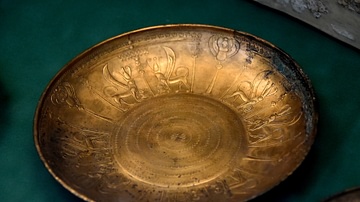
Phoenician Bronze Bowl From Nimrud
This bowl was part of a hoard found by Sir Henry Layard in 1850-1851 CE in the North-West Palace at Nimrud (ancient Kalhu). They were probably deposited there in the 8th century BCE. The decoration on the bowls is Phoenician, very similar...
Image
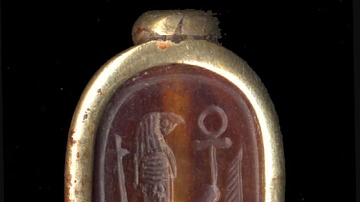
Phoenician Scarab Seal
A Phoenician carved scarab seal (sard and gold) depicting the hawk of Horus holding an ankh and a feather of Maat. 750-500 BCE. (British Museum, London)
Image
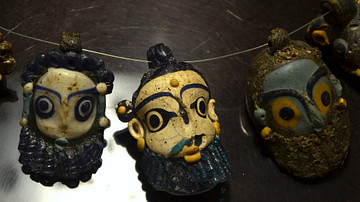
Phoenician/Punic Necklace with Amulets
Phoenician or Carthaginian amulets in the form of bearded heads made of sand-core glass, 4th-3rd century BCE (Cagliari, Museo Archeologico Nazionale).
Image
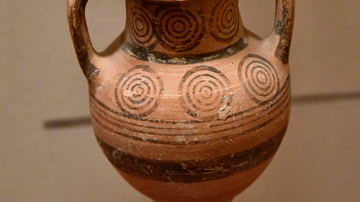
Cypro-Phoenician Pottery Vessel
This vessel belongs to a ceramic tradition known as "black-on-red" ware, the most ubiquitous of the Iron Age's Cypro-Phoenician exports. Iron Age II, 1000-539 BCE. From Amman, Jordan. (The Jordan Museum, Amman, Jordan).
Image
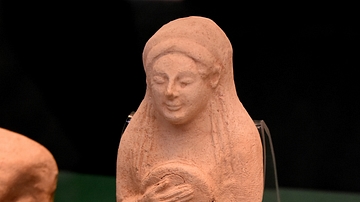
Phoenician Tambourine Player from Tharros
This is a baked clay votive figurine of woman playing a tambourine. The curls of her hair show a Greek influence. The Canaanite traditions of terracotta figurine manufacturer were continued by the Phoenicians, both at home and in the colonies...
Image
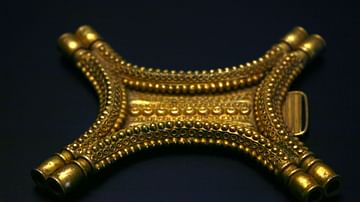
Phoenician-Punic Gold Pectoral
A Phoenician-Punic gold pectoral, 8th-7th Century BCE. From the El Carambolo Treasure, Seville. (National Archaeological Museum, Madrid)

Image
Head of a Phoenician Woman
This is a head of woman wearing an Egyptian wig. The hole at the top is a hole for suspension. Part of a baked clay votive figure. The Canaanite traditions of terracotta figurine manufacturer were continued by the Phoenicians, both at home...
Article
A Linguistical Analysis of Ancient Celtic Languages
The Celtic languages form a branch of the Indo-European (IE) language family. They derive from Proto-Celtic and are divided into Continental Celtic languages (Lepontic, Gaulish, Galatian, Noric, Celtiberian, Gallaecian) and Insular Celtic...

Video
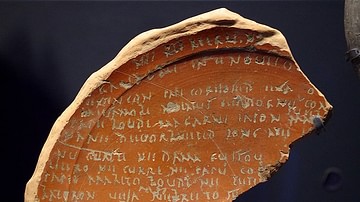
Etruscan Alphabet
This video covers the basic development of the Etruscan Alphabet from the Archaic to Neo-Etruscan period. The 2 book referenced at the end of the video: The Etruscan Language by Larissa and Giuliano Bonfonte http://amzn.to/1cXgfTk...
