
Search
Remove Ads
Advertisement
Search Results
Image
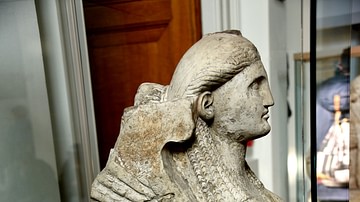
Greek Sphinx, British Museum
Greek sphinx that may once have guarded the tomb of a Greek inhabitant in Egypt. Roman Egypt, 2nd century CE. In Greek mythology, the sphinx was a monster with the head of a woman, a bird's wings, the body of a lion...
Image
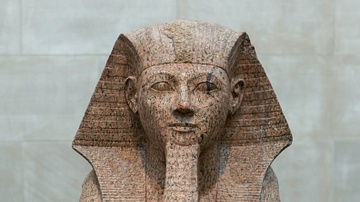
Sphinx of Hatshepsut
Sphinx of Hatshepsut (ca. 1479–1458 BCE). This colossal sphinx portrays the female pharaoh Hatshepsut with the body of a lion and a human head wearing a nemes–headcloth and false beard. The sculptor has carefully observed...
Image
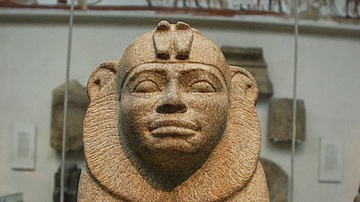
Taharqa Sphinx
Granite sphinx of Taharqa, 25th Dynasty, c. 690-664 BCE. This statue from Kawa (Temple T) in Sudan shows the Pharaoh's face on a Lion figured sphinx, a form of royal representation borrowed from Middle and New Kingdom art. Taharqa...

Definition
Great Zimbabwe
Great Zimbabwe is a ruined city near Masvingo, central Zimbabwe which was inhabited between c. 1100 to c. 1550 (flourishing c. 1300 - c. 1450) in the region’s Late Iron Age. Capital of the Kingdom of Zimbabwe of the Bantu-speaking...

Definition
Great Northern War
The Great Northern War took place from 1700 to 1721 and was fought between Russia and Sweden during the reign of Peter I of Russia (Peter the Great). One of the key causes of the war was Peter the Great’s desire to have territory...
Image
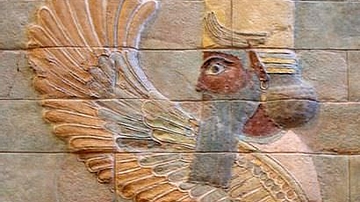
Winged Sphinx of Susa
Winged Sphinx from the palace of Darius the Great (549-486 BCE) at Susa.

Image
Phoenician Ivory Sphinx Plaque
This ivory plaque is part of the so-called "Nimrud Ivories." The sphinx wears the typical Egyptian Pharaohs' double crown and an apron with cobra. This indicates that the plaque was made by a Phoenician craftsman...

Image
Oedipus & the Sphinx of Thebes
A red-figure tondo showing Oedipus and the sphinx of Thebes, from Vulci, 470 BCE.
Vatican Museums, Rome.

Image
Nimrud Ivory Plaque of an Egyptian Sphinx
A winged human-headed sphinx wears the double crown of Egypt. An apron hangs down on the chest with a projecting uraeus (rearing cobra) similar to those worn by Egyptian pharaohs. A striking Phoenician style...
Image
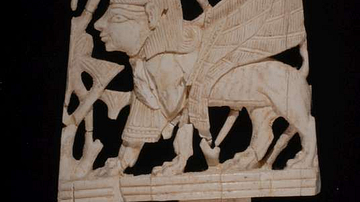
Ivory Furniture Inlay with Sphinx
This object is an ivory furniture inlay depicting a striding sphinx. It was excavated from Samaria and dates to the Iron Age II (9th–8th century BCE). It has a length of 7.5 cm and a width of 7 cm. (The Israel Museum...
