
Search
Did you mean: Fates?
Remove Ads
Advertisement
Search Results

Definition
Titan - The Gods Defeated by the Greek Olympians
In Greek mythology the terrible and powerful Titans were those deities which preceded the Olympian gods. Never worshipped as the other gods, they nevertheless helped, through contrast, to clarify the position...
Definition
Prairial Uprising
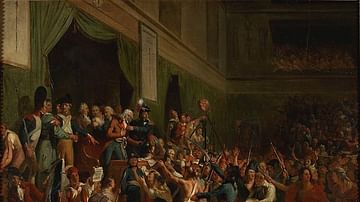
The Uprising of 1 Prairial Year III (20 May 1795) was the last major popular insurrection during the French Revolution (1789-1799). It was the final time that the sans-culottes played an important role in French politics until...

Article
Enuma Elish - The Babylonian Epic of Creation - Full Text
The Enuma Elish (also known as The Seven Tablets of Creation) is the Babylonian creation myth whose title is derived from the opening lines of the piece, "When on High". The myth tells the story...

Article
The Mesopotamian Pantheon - The Ancient Gods and Goddesses of the Near East
The gods of the Mesopotamian region were not uniform in name, power, provenance or status in the hierarchy. Mesopotamian culture varied from region to region and, because of this...

Article
Nine Realms of Norse Cosmology
Norse cosmology divided the universe into nine realms. The center of the universe was the great world-tree Yggdrasil and the nine realms either spread out from the tree or existed in levels stretching from the roots...

Article
A Visual Who's Who of Greek Mythology
Achilles The hero of the Trojan War, leader of the Myrmidons, slayer of Hector and Greece's greatest warrior, who sadly came unstuck when Paris sent a flying arrow guided by Apollo, which caught him in his...

Article
Roman Household Spirits: Manes, Panes and Lares
To the ancient Romans, everything was imbued with a divine spirit (numen, plural: numina) which gave it life. Even supposedly inanimate objects like rocks and trees possessed a numen, a belief which no...

Article
Viking Prophecy: The Poem Völuspá of the Poetic Edda
The Völuspá (Old Norse: Vǫluspá) is a medieval poem of the Poetic Edda that describes how the world might have come into shape and would end according to Norse mythology. The story of about 60 stanzas...

Article
Prayer to Thoth for Skill in Writing
The Prayer to Thoth for Skill in Writing is a literary piece dated to c. 1150 BCE from the latter period of the New Kingdom of Egypt (c. 1570- c. 1069 BCE) in which a young scribe prays for inspiration to Thoth...

Article
Diodorus Siculus on Fate and Philip of Macedon
Diodorus Siculus, the 1st century BCE historian, took great pride in precision of description but, even so, could not refrain from adding his own personal views and interpretations of historical events...
