
Search
Did you mean: Bacchae?
Remove Ads
Advertisement
Search Results

Video
Dionysus the God of Wine, Festivity, and Theatre
Dionysus, who was also known as Bacchus to both the Greeks and the Romans, was the ancient Greek god of wine, theatre, madness and wild frenzy, merriment, and vegetation. Like most other Greek deities...

Definition
First Triumvirate
The First Triumvirate of ancient Rome was an uneasy alliance between the three titans Julius Caesar, Pompey, and Crassus which, from 60 BCE until 53 BCE, dominated the politics of the Roman Republic. Alliances have always been...

Definition
Ancient Greek Dance
In ancient Greece, dance had a significant presence in everyday life. The Greeks not only danced on many different occasions, but they also recognized several non-performative activities such as ball-playing or rhythmic physical...

Definition
Silenus
Silenus (also spelt Silenos) is a rustic god of the forest, drunkenness and wine-making in Greek mythology. He is best known as the companion and foster father of the god Dionysos. Silenus is closely associated with the satyrs, sometimes...
Definition
The Children of Heracles
The Children of Heracles (Heraclidae) is one of Euripides' lesser-known and least popular works, as is the myth surrounding the tragedy play. Its date is also uncertain, possibly written in the late 430s or early 420s BCE...

Article
Battle of Carrhae, 53 BCE
The Battle of Carrhae in 53 BCE was one of the greatest military catastrophes in all of Roman history when a hero of the Spartacus campaign, Marcus Licinius Crassus (115-53 BCE), initiated an unprovoked invasion of Parthian...
Image
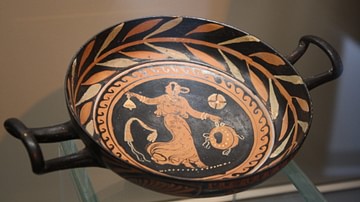
Maenad, Red-Figure Cup
Greek red figure stemless cup from Apula, 330-320 BCE, depicting a dancing maenad - female follower of Dionysus - holding a bell and tambourine. (Archaeological Museum, Milan)
