
Search
Did you mean: Hades?
Remove Ads
Advertisement
Search Results

Definition
Medes
The Medes or Medians were a group of Indo-Iranian-speaking people from central Asia who migrated westwards and entered northern Iran around the end of the 2nd millennium BCE. They settled in the highlands of Zagros (Zagreus in Greek...

Definition
Lycurgus
Lycurgus is considered the semi-mythical founder of classical Sparta and responsible for all of the city-state’s laws as well as its military and political institutions. He became better known to generations of Spartans as the lawgiver...

Definition
Parmenides
Parmenides (l.c. 485 BCE) of Elea was a Greek philosopher from the colony of Elea in southern Italy. He is considered among the most important of the Pre-Socratic philosophers who initiated philosophic inquiry in Greece beginning...
Definition
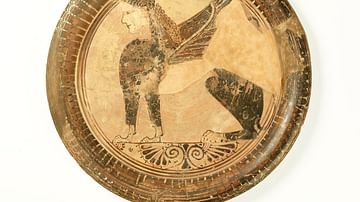
Naukratis
Naukratis (also spelled Naucratis, and known as Nokraji to the ancient Egyptians) was a city in Lower Egypt, located in the Canopic (or western) branch of the Nile delta, which became a powerful trading port between the Egyptians and...

Definition
Zeno of Elea
Zeno of Elea (l. c.465 BCE) was a Greek philosopher of the Eleatic School and a student of the elder philosopher Parmenides (l.c. 485 BCE) whose work influenced the philosophy of Socrates (l. c. 470/469-399 BCE). Zeno and Parmenides...

Definition
Xenophanes of Colophon
Xenophanes of Colophon (l. c. 570 to c. 478 BCE) was a Greek philosopher born 50 miles north of Miletus, a city famed for the birth of philosophy and home to the first Western philosopher, Thales of Miletus (l. c. 585 BCE...

Definition
War in Ancient Times
The word 'war' comes to English from the old High German language word Werran (to confuse or to cause confusion) through the Old English Werre (meaning the same), and is a state of open and usually declared armed conflict...

Article
Ten Ancient Mesopotamia Facts You Need to Know - Fun Facts on the Cradle of Civilization
Mesopotamia is the ancient Greek name (meaning "the land between two rivers," the Tigris and Euphrates) for the region corresponding to modern-day Iraq and parts of Iran...

Article
Ancient Egyptian Science & Technology
The great temples and monuments of ancient Egypt continue to fascinate and amaze people in the modern day. The sheer size and scope of structures like the Great Pyramid at Giza or the Temple of Amun at Karnak...

Article
Plato: The Name and The Poet
Plato (l. c. 424/423 to 348/347 BCE), the Greek philosopher whose works have significantly shaped Western thought and religion, is said to have initially been a poet and playwright and, even if the primary source of...
