
Search
Remove Ads
Advertisement
Search Results

Definition
Year of the Four Emperors - When Four Men Battled For Control of the Roman Empire
The Year of the Four Emperors (69 CE) was a brief period of political upheaval and civil war in the Roman Empire. In the aftermath of the death of Emperor Nero, four men – Galba...

Definition
Caesarion
Ptolemy XV Caesar “Theos Philopator Philometor” (“the Father-loving Mother-loving God”) (c. 47-30 BCE), better known by his unofficial nickname Caesarion or “Little Caesar” in Greek, was the oldest son of Cleopatra VII (69-30 BCE...

Definition
Religion in the Ancient World - Order and the Spiritual Experience
Religion (from the Latin Religio, meaning "restraint," or Relegere, according to Cicero, meaning "to repeat, to read again," or, most likely, Religionem, "to show respect for what is sacred"...

Image
The Great Temple of Hattusa
The area of the Great Temple located in the Lower City of Hattusa (the capital of the Hittite Empire in the Late Bronze Age). The temple was built in the 14th century BCE and was dedicated to the supreme deities of the...
Image
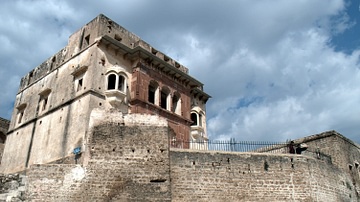
Ram Chandra Temple (Katas Raj)
The Ram Chandra temple is a prominent part of Katas Raj complex of early Hinduism, situated in the District of Chakwal in the Punjab, Pakistan. This site is a complex and dates back to the 3rd century BCE. A Buddhist...
Image
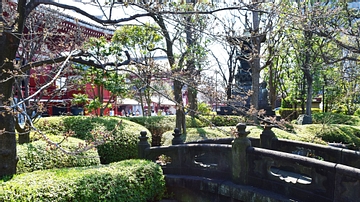
Japanese Gardens around Sensoji Temple
Founded in 645 CE, Sensoji Temple is the oldest and most important Buddhist temple in Tokyo, Japan. It is surrounded by gardens, other temples, and the Asakusa Shinto Shrine.
Image
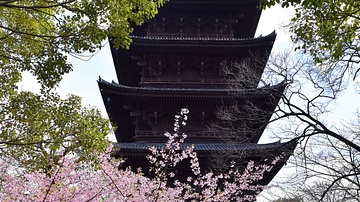
Kyoto's Five-Story Pagoda at Toji Temple
Toji temple in Kyoto, Japan was first built between 794-796 CE by decree of Emperor Kammu (r. 781-806 CE). The temple complex contains a five-story pagoda, which stands 54.8 m (180 ft) high. It is the tallest...
Image
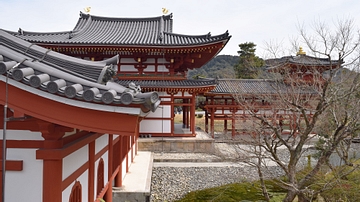
Byodoin Temple in Uji, Japan
The Byodoin Temple in Uji, Japan dates from the late-Heian period, and it served as the residence of the influential minister Fujiwara no Michinaga (966-1028 CE). It was originally built in 998 CE. The most famous portion...

Image
The Temple of Apollo at Claros
The Temple of Apollo at Claros (also called Klaros) was a very important center of prophecy as in Delphi and Didyma. The building of the temple started at the beginning of the 3rd century BCE.
Image
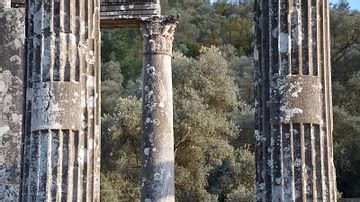
Columns of the Temple of Zeus Lepsynos, Euromos
Inscriptions on the flutted columns of the Temple of Zeus Lepsynos at Euromos celebrating the donors who financially supported the construction of the temple.
