
Search
Remove Ads
Advertisement
Search Results
Image
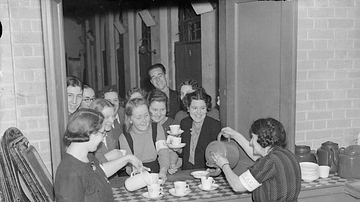
Volunteers Distributing Tea during the London Blitz
A photograph showing tea being distributed by volunteers to air raid shelters during the London Blitz of 1940-1. John Keble Church kitchen. (Imperial War Museums)
Image
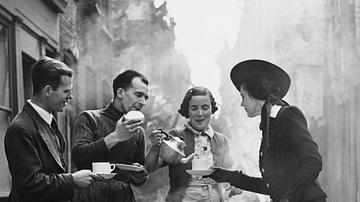
Tea in the Blitz
A cafe owner sells tea in the street during the London Blitz (1940-1). (Imperial War Museums)

Definition
Religion in the Ancient World - Order and the Spiritual Experience
Religion (from the Latin Religio, meaning "restraint," or Relegere, according to Cicero, meaning "to repeat, to read again," or, most likely, Religionem, "to show respect for what is sacred"...

Definition
Portuguese Macao
Macao (Macau) is located on a peninsula in the estuary of the Pearl River delta in southeast China and it was a Portuguese colonial settlement from c. 1557 until 1999. Macao was a major trade hub of the Portuguese Empire and with...

Definition
Ghosts in the Ancient World - The Return of the So-Called Dead
A belief in an afterlife was central to every major civilization of the ancient world and this encouraged the recognition of the reality of ghosts as the spirits of the departed who, for one...

Definition
Marco Polo
Marco Polo (1254-1324 CE) was a Venetian merchant and explorer who travelled to China and served the Mongol ruler Kublai Khan (l. 1214-1294 CE) between c. 1275 and 1292 CE. Polo's adventures are recounted in his own writings, The...

Article
The Mandate of Heaven and The Yellow Turban Rebellion
Throughout history, in order for a government to be respected and obeyed, it must possess some form of legitimacy recognized by the governed. Governmental systems have relied on a number of models...

Definition
Silk in Antiquity
Silk is a fabric first produced in Neolithic China from the filaments of the cocoon of the silk worm. It became a staple source of income for small farmers and, as weaving techniques improved, the reputation of Chinese silk spread...

Article
Slavery in Plantation Agriculture
The first plantations in the Americas of sugar cane, cocoa, tobacco, and cotton were maintained and harvested by African slaves controlled by European masters. When African slavery was largely abolished in the mid-1800s...

Article
A Brief History of the Rose
The rose that grows in many different forms in gardens all over the world today is an evolution of rose-like plants that lived in the northern hemisphere between 33 million and 23 million years ago. Traces of them have...
