
Search
Did you mean: Troy?
Remove Ads
Advertisement
Search Results

Interview
Interview: Shung Ye Museum of Formosan Aborigines
Indigenous peoples of Austronesian ancestry are the original inhabitants of Taiwan. Taiwanese indigenous peoples — formerly called Taiwanese aborigines, Formosan people, and Gaoshan (臺灣原住民族) — lived in relative isolation for over 5,000 years...

Definition
Ancient China
Ancient China produced what has become the oldest extant culture in the world. The name 'China' comes from the Sanskrit Cina (derived from the name of the Chinese Qin Dynasty, pronounced 'Chin') which was translated as 'Cin' by the Persians...

Definition
Tang Dynasty
The Tang Dynasty (618-907 CE) was one of the greatest in Imperial Chinese history. It was a golden age of reform and cultural advancement which lay the foundation for policies which are still observed in China today. The second emperor, Taizong...

Definition
Zheng Yi Sao
Zheng Yi Sao (aka Ching Shih, Cheng I Sao, Ching Yih Saou or Mrs Cheng, d. 1844) was the chief of a massive pirate confederation which plundered the South China Sea in the early 19th century. She inherited the role from her late husband...

Definition
Parthia (Empire)
The Parthians ruled from 247 BCE to 224 CE creating a vast empire that stretched from the Mediterranean in the west to India and China in the east. East of the Caspian Sea there emerged from the steppe of Central Asia a nomadic Scythian tribe...

Definition
Tamar of Georgia
Tamar was the queen of Georgia from 1184 to 1213 CE. She is considered one of the greatest of medieval Georgia's monarchs, and she presided over its greatest territorial expansion, taking advantage of the decline of other major powers in...
Definition
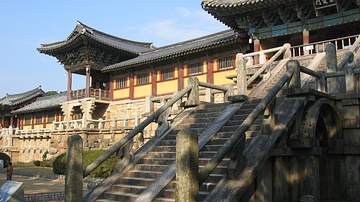
Bulguksa Temple
The Bulguksa Temple (aka Pulguk-sa Temple or 'Temple of the Buddha Land') was built in the 8th century CE on the wooded slopes of Mt. Tohamsan at the ancient Silla capital of Geumseong (modern Gyeongju, South Korea). The Buddhist temple...
Definition
Emperor Xuanzong of Tang
Xuanzong (birth name, Li Longji, l. 685-762 CE, r. 712-756 CE) was the 7th emperor of the Tang Dynasty of China, whose domestic and foreign policies established the Tang Dynasty as the Golden Age in Chinese history. Many of the most important...

Definition
Ancient Korean Coinage
The coinage of ancient Korea (pre-13th century CE) first employed Chinese coins, known locally as the oshuchon. Korean rulers began minting their own metal coins from the late 10th century CE, first in copper and iron, and later in bronze...

Definition
Teng Shih
Teng Shih (l. c. 500 BCE) was a Chinese Sophist and lawyer who lived and wrote in the province of Cheng (Pengcheng, modern-day Xuzhou, Jiangsu province) during the era of the Spring and Autumn Period (c. 772-476 BCE) which preceded the Warring...
