
Search
Remove Ads
Advertisement
Search Results

Definition
Cambyses II
Cambyses II (r. 530-522 BCE) was the second king of the Achaemenid Empire. The Greek historian Herodotus portrays Cambyses as a mad king who committed many acts of sacrilege during his stay in Egypt, including the slaying of the sacred Apis...

Definition
Gurjara-Pratihara Empire
The Gurjara-Pratiharas, or simply, the Pratiharas (8th century CE - 11th century CE) held their sway over western and northern India. This dynasty saw its fortunes rising under Nagabhata I (730–760 CE) who successfully defeated Arab invaders...
Definition
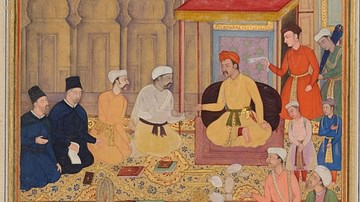
Ibadat Khana
The House of Worship or the Ibadat Khana was established by Mughal Emperor Akbar (1542-1605 CE) for conducting religious debates and discussions among theologians and professors of different religions. Abu'l-Fath Jalal-ud-din Muhammad Akbar...

Definition
Parthian Culture
Stretching between China and India in the east to the Mediterranean in the west, Parthia ruled over one of the widest expanses of empire in its time and Parthian culture flourished for 500 years (247 BCE to 224 CE). While known for their...

Article
Azulejos: The Visual Art of Portugal
Glazed blue ceramic tiles or azulejos are everywhere in Portugal. They decorate the winding streets of the capital, Lisbon. They cover the walls of train stations, restaurants, bars, public murals, and fountains, churches, and altar fronts...

Image
Map of the Trade in the Indian Ocean 15th-16th century - From Afro-Asian Exchange to European Intervention
The Indian Ocean trade network of the 15th and 16th centuries formed one of the most extensive and dynamic systems of exchange in the premodern world, linking East Africa, the Middle East, South Asia, and Southeast Asia. This maritime system...

Image
Map of the Seljuk Sultanate of Rum, c. 1200
The Seljuk Sultanate of Rûm (1077–1308 CE) emerged in the aftermath of the Seljuk victory over Byzantium at the Battle of Manzikert (1071), which opened Anatolia to Turko-Persian expansion. The term Rûm (derived from the Greek Rhomaioi, “Romans,”...

Image
Mosque of the Dome of the Rock
Mosque of the Dome of the Rock (Qubbat al-Sakhra) located on the Temple Mount in Jerusalem. It was erected by the Muslim caliph Abd el-Malik in 688-691 CE but Suleiman the Magnificent (1520-1566 CE) was responsible for the mosque’s renovation...
Image
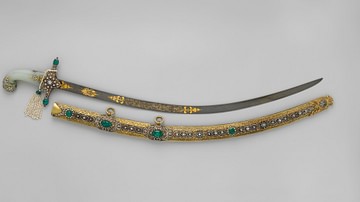
Ottoman Sword of State
An Ottoman sword of state, used during inauguration ceremonies for sultans. The sword was refitted in 1876 CE for the planned inauguration of the Ottoman sultan Murad V (r. 1876 CE). The sword is comprised of a 17th Century CE Iranian steel...

Image
Great House, Kilwa
The ruins of the Great House, Kilwa on the Swahili Coast (modern Tanzania). Likely constructed during the reign of al Hasan ibn Suleiman (r. 1320-1333 CE).
