
Search
Remove Ads
Advertisement
Search Results

Definition
Hippocrates
Hippocrates was born on the Greek island of Kos in the 5th century BCE, and he became the most famous physician in antiquity. He established a medical school on the island, wrote many treatises on medical matters, and is, through...

Definition
Archelaus (Philosopher)
Archelaus of Athens (l. c. 5th century BCE) was a Pre-Socratic philosopher in ancient Greece who claimed the first cause of existence was the opposition of cold and heat which caused the separation of the universal essence...

Definition
The Clouds
The Clouds is a comedy written c. 423 BCE by the Greek playwright Aristophanes (c. 448 BCE – c. 385 BCE). A failure at the Dionysia competition, finishing third out of three, it was revised later in 418 BCE but never produced in the...

Definition
Hipparchia of Maroneia
Hipparchia of Maroneia (l. c. 350-280 BCE) was a Cynic philosopher who rejected her upper-class life to live her beliefs and share her values on the streets of ancient Athens. She was the wife of the Cynic Crates of Thebes...
Definition
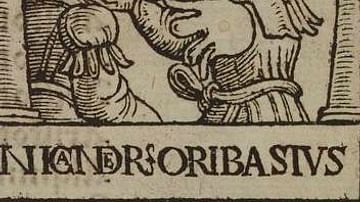
Oribasius
Oribasius (c. 320-400/403 CE) was the physician and political advisor of the Roman emperor Julian the Apostate (r. 361-363 CE). A native of Pergamon, a rich and powerful Greek city in Mysia, he studied medicine and oratory and belonged...

Article
Greek Mathematics
Greek mathematics, the study of numbers and their properties, patterns, structure, space, apparent change, and measurement, is said to have originated with Thales of Miletus (l. c. 585 BCE) but was clearly understood during the...

Article
Travel in the Ancient Greek World
Travel opportunities within the ancient Greek world largely depended on status and profession; nevertheless, a significant proportion of the population could, and did, travel across the Mediterranean to sell their...
Article
Xenophon's Defense of Socrates
Xenophon's Defense of Socrates (c. 371 BCE) is a passage from the Memorabilia of Xenophon (l. 430 to c. 354 BCE) in which he addresses the teachings and actions of Socrates of Athens and denounces the charges against...

Article
The Plays of Cratinus
Cratinus was a highly successful writer of Attic Old Comedy, but the very fragmentary nature of his surviving plays means that he is not as well remembered as Aristophanes (eleven of whose plays come down to us intact). Despite...

Article
The Life of Antisthenes of Athens in Diogenes Laertius
Antisthenes (c. 445-365 BCE) was a Greek philosopher who founded the Cynic School of Athens. He was a follower of Socrates and appears in Plato's Phaedo as one of those present at Socrates' death...
