
Search
Remove Ads
Advertisement
Search Results

Image
Australian Troops, Siege of Tobruk
Australian troops at the Siege of Tobruk (Apr-Dec 1941) in the Western Desert Campaigns in North Africa during the Second World War (1939-45). (Imperial War Museums)

Image
The Siege of La Rochelle, 1573
A 1623 tapestry showing the siege of Protestant-held La Rochelle in 1573 during the French Wars of Religion (1562-1598).
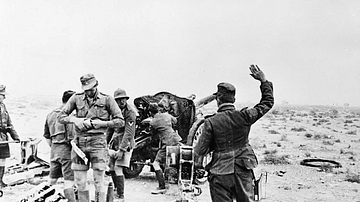
Image
German Artillery, Siege of Tobruk
German artillery at the Siege of Tobruk (1941-2) in the Western Desert Campaigns in North Africa during the Second World War (1939-45). (Imperial War Museums)

Image
Map of the Siege of Savannah
Map depicting the Siege of Savannah, 16 September to 20 October 1779. Illustration from page 171 of the book British Battles on Land and Sea Vol. 2, by James Grant, London, 1873.
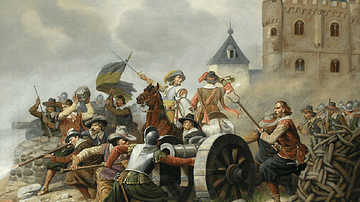
Image
Castle Siege by Christian Sell
A 19th-century painting of a castle siege during the Early-modern period. Painted by Christian Sell (1831-83).
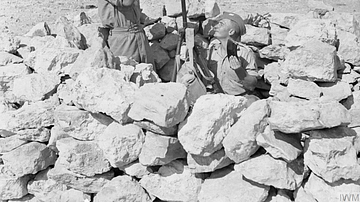
Image
Polish Troops at the Siege of Tobruk
A photograph of Polish soldiers during the Siege of Tobruk (Apr-Dec 1941) in the Western Desert Campaigns in North Africa during the Second World War (1939-45). Taken in September 1941. (Imperial War Museums)
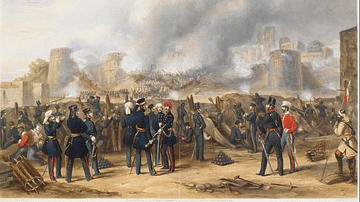
Image
The Siege of Multan
A mid-19th-century illustration showing the siege of Multan by the British East India Company during the Second Anglo-Sikh War (1848-9) against the Sikh Empire.

Definition
Sennacherib
Sennacherib (r. 705-681 BCE) was the second king of the Sargonid Dynasty of Assyria (founded by his father Sargon II, r. 722-705 BCE). He is one of the most famous Assyrian kings owing to the part he plays in narratives in the biblical Old...

Image
Siege of Alesia
This is an artistic 3D model of how the Battle of Alesia may have looked.
In this decisive Roman victory (September 52 BCE), Julius Caesar defeated the Arverni leader Vercingetorix, completing the Roman conquest of Gaul.
Image
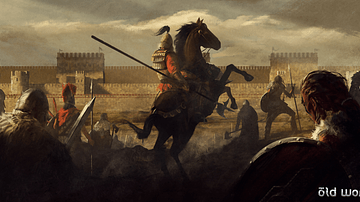
City Under Siege
Artist's impression of an army in front of a large city wall, most likely during Late Antiquity or the early Middle Ages. While this does not depict any specific event, the walls may represent the Theodosian Walls of Constantinople.
