
Search
Did you mean: Noah?
Remove Ads
Advertisement
Search Results

Image
Triple-Based Stupa, Harwan Monastery
Triple based stupa in Harwan Monastery in diaper rubble style. Kashmir, India.

Image
Rooms in the Harwan Monastery Complex
Set of rooms which might have been used for residential purposes or as a chapel. Part of the Harwan Monastery in Kashmir, India.
Image
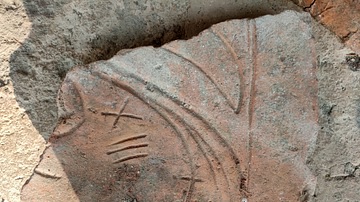
Decorated Tile from the Harwan Monastery
A fragmented tile found in the complex, impressed with Kharoshti numerals. From the Harwan Monastery in Kashmir, India.

Definition
Ancient Persian Culture
Ancient Persian culture flourished between the reign of Cyrus II (The Great, r. c. 550-530 BCE), founder of the Achaemenid Persian Empire, and the fall of the Sassanian Empire in 651 CE. Even so, the foundations of Persian culture were already...

Definition
East India Company
The English East India Company (EIC or EEIC), later to become the British East India Company, was founded in 1600 as a trading company. With a massive private army and the backing of the British government, the EIC looted the Indian subcontinent...

Definition
Justinian I
Justinian I reigned as emperor of the Byzantine Empire from 527 to 565 CE. Born around 482 CE in Tauresium, a village in Illyria, his uncle Emperor Justin I was an imperial bodyguard who reached the throne on the death of Anastasius in 518...

Definition
Ancient Persian Government
The government of ancient Persia was based on an efficient bureaucracy which combined the centralization of power with the decentralization of administration. The Achaemenid Empire (c. 550-330 BCE) founded by Cyrus the Great (r. c. 550-530...

Definition
Xerxes I
Xerxes I (l. 519-465, r. 486-465 BCE), also known as Xerxes the Great, was the king of the Persian Achaemenid Empire. His official title was Shahanshah which, though usually translated as `emperor', actually means `king of kings'. He is identified...

Definition
Qilin (Chinese Unicorn)
The qilin (麒麟, or simply lin 麟) is a Chinese mythical creature, frequently translated as "Chinese unicorn." While this term may suggest a one-horned creature, the qilin is often depicted with two horns. However, like the Western unicorn...

Definition
Persian Immortals
The Ten Thousand Immortals were the elite force of the Persian army of the Achaemenid Empire (c. 550-330 BCE). They formed the king's personal bodyguard and were also considered the shock troops of the infantry in Persian warfare. They are...
