
Search
Did you mean: Noah?
Remove Ads
Advertisement
Search Results
Definition
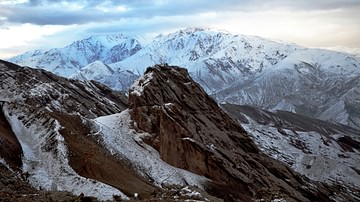
The Assassins
The Assassins (aka Nizari Ismailis), were a heretical group of Shiite Muslims who were powerful in Persia and Syria from the 11th century CE until their defeat at the hands of the Mongols in the mid-13th century CE. Secure in their fortified...

Article
Saladin & the Unification of the Muslim Front: 1169-1187 CE
Saladin (c. 1137 – 1193 CE), the Muslim ruler who crushed the mighty Crusader army at the Horns of Hattin (1187 CE) and re-took Jerusalem after 88 years of Crusader control, was born in a world where the disunity of the Muslims had allowed...

Definition
Genghis Khan
Genghis Khan (aka Chinggis Khan) was the founder of the Mongol Empire which he ruled from 1206 until his death in 1227. Born Temujin, he acquired the title of Genghis Khan, likely meaning 'universal ruler’, after unifying the Mongol tribes...

Definition
Kalash Culture
The Kalash people, also called Kafir (Non-believer), Black Robe and Siah Posh, live in the three sub-valleys of Kalash; Bumboret, Rumbor and Birir, in the modern-day District Chitral, Pakistan. The Kalasha are ancient tribe of Pakistan and...

Definition
Persian Seven-Colored Tiles
Persian Haft Rang tiles, also known as seven-colored tiles, are highly decorative glazed tiles used to adorn the exteriors and interiors of both secular and religious buildings. The tiles first came to prominence from the 15th century and...

Article
Ten Great Persian Poets
Persian literature derives from a long oral tradition of poetic storytelling. The first recorded example of this tradition is the Behistun Inscription of Darius I (the Great, r. 522-486 BCE), carved on a cliff-face c. 522 BCE during the period...

Article
The English and Dutch East India Companies' Invasions of India
In the early 17th century, the Dutch and English East India Companies turned their eyes towards India, as part of their grand schemes to develop extensive trade networks across the Indian and China Seas. They were faced with two significant...

Article
Battles & Conquests Of The Ottoman Empire (1299-1683)
Spanning across three continents and holding dominance over the Black and Mediterranean Seas, the Ottoman Sultanate (1299-1922) was a global military superpower between the 15th and 17th centuries. From the point of its inception in 1299...
Article
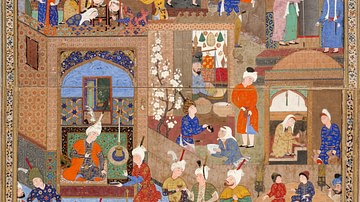
Persian Miniature Painting
Persian miniature painting is a courtly and aristocratic art, with exquisite colors, balanced compositions, and meticulous attention to detail. Although its origins can be difficult to trace, many consider the Arzhang, the illustrated book...
Image
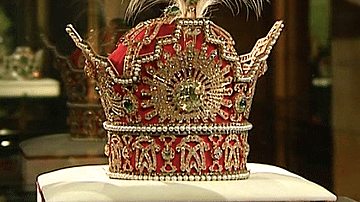
The Pahlavi Crown
The Pahlavi Crown, first worn by Reza Shah Pahlavi, Shah of Iran, at his coronation in April 1926. The design reminds of the rulers of the Sassanid dynasty (3rd-7th centuries CE). Made of gold and silver on a red velvet backing. Weighing...
