
Search
Search Results

Definition
Anglo-Saxon Warfare
Anglo-Saxon warfare was characterised by frequent and violent conflicts between petty kings, which ultimately led to the rise of larger kingdoms such as the Kingdom of Mercia, the Kingdom of Northumbria, and the Kingdom of Wessex. In early...
Definition
Gauda Kingdom
The Gauda Kingdom came into being in the late 6th century CE in eastern India, as a result of the political disintegration of the Gupta Empire (3rd-6th century CE). Its core areas were situated in what is now the state of Bengal in India...

Definition
Carthaginian Army
The armies of Carthage permitted the city to forge the most powerful empire in the western Mediterranean from the 6th to 3rd centuries BCE. Although by tradition a seafaring nation with a powerful navy, Carthage, by necessity, had to employ...
Definition
Syracusia
The Syracusia was an ancient sailing vessel designed by Archimedes in the 3rd century BCE. She was fabled as being one of the largest ships ever built in antiquity and as having a sumptuous decor of exotic woods and marble along with towers...
Definition
Naukratis
Naukratis (also spelled Naucratis, and known as Nokraji to the ancient Egyptians) was a city in Lower Egypt, located in the Canopic (or western) branch of the Nile delta, which became a powerful trading port between the Egyptians and the...
Definition
Ino
Ino is a princess of Thebes and the wife of King Athamas of Boeotia in Greek mythology. She helped to raise Dionysos, the god of wine, but the most famous myth associated with her is her descent into madness and the tragic fate of her family...

Definition
William Dampier
William Dampier (1651-1715) was an English explorer, navigator, and naturalist, who was the first person to circumnavigate the world three times. He was also among the first Englishmen to step foot on Australian soil when he sailed into King...

Definition
Freyr
Freyr (Old Norse for 'Lord', sometimes anglicised as Frey) is the main fertility god in Norse mythology, his connection with harvests, sun and rain, virility, weddings, and his rule over wealth securing him an important position within the...

Definition
Amber in Antiquity
Amber, the fossilised resin of trees, was used throughout the ancient world for jewellery and decorative objects. The main source was the Baltic region where amber, known to mineralogists as succinite, was washed up onto beaches and easily...
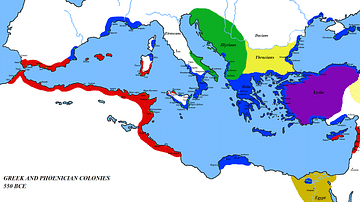
Definition
Uat-Ur
Uat-Ur was the ancient Egyptian name for the Mediterranean Sea (also known as Wadj-Wer) and is translated as 'the Great Green'. Uat-Ur was understood as a living entity imbued with the spirit of the divine which, like all other aspects of...
