
Search
Did you mean: Script?
Remove Ads
Advertisement
Search Results

Definition
Nabu - The Babylonian God of Wisdom and Writing
Nabu (sometimes known as Tutu) was the Babylonian god of wisdom, learning, prophecy, scribes, and writing, also responsible for the abundant harvest and all growing things. His name means "the Announcer,"...

Definition
Leo Africanus
Leo Africanus (al-Hasan ibn Muhammad ibn Ahmad al-Wazzan al-Fasi al-Granati, 1485-1554) was a diplomat, merchant traveller and scholar who famously voyaged from Timbuktu to the Niger River and wrote 'The Description of Africa' (La...
Definition
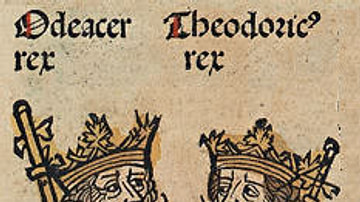
Theodoric the Great
Theodoric the Great (l. c. 454-526 CE, r. 493-526 CE, also known as Flavius Theodoricus) was the king of the Ostrogoths who, at the encouragement and direction of the Roman emperor Zeno, invaded Italy, deposed King Odoacer...

Definition
The Westcar Papyrus
The ancient Egyptians enjoyed storytelling as one of their favorite pastimes. Inscriptions and images, as well as the number of stories produced, give evidence of a long history of the art of the story in Egypt dealing with...
Definition
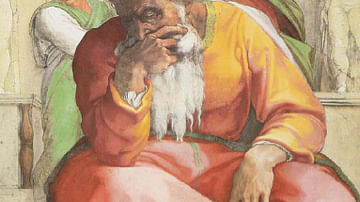
Jeremiah
Jeremiah (c. 650-570 BCE) was a major prophet of Israel in the Hebrew Bible. In addition to his book of prophecy, he is also credited with writing the Books of Kings and Lamentations (perhaps written by his scribe, Baruch). Called to...

Definition
Samuel
Samuel is a character in the Hebrew Bible and the Old Testament, uniquely depicted as having served several roles, as judge, military leader, seer, prophet, kingmaker, priestly official, and loyal servant of Yahweh. He is traditionally...

Article
Daily Life in Ancient Mesopotamia - Mirroring the Modern World
Daily life in ancient Mesopotamia cannot be described in the same way one would describe life in ancient Rome or Greece. Mesopotamia was never a single, unified civilization, not even under...
Article
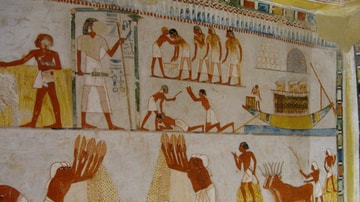
Social Structure in Ancient Egypt
The society of ancient Egypt was strictly divided into a hierarchy with the king at the top and then his vizier, the members of his court, priests and scribes, regional governors (eventually called 'nomarchs'), the...

Article
Vikings TV Series - Historical Accuracy
Vikings (2013-present) is a historical fiction TV series created and written by English screenwriter Michael Hirst for the History Channel. Filmed in Ireland, the show draws on Scandinavian and European history...
Article
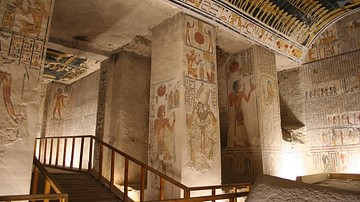
Tomb Robbing in Ancient Egypt
The tombs of the great kings and nobles of Egypt were built to safeguard the corpse and possessions of the deceased for eternity and yet, while many have endured for thousands of years, their contents often disappeared...
