
Search
Did you mean: Saturn?
Remove Ads
Advertisement

 This answer was generated by
 Search Results
Article
The Satire of the Trades
The literature of ancient Egypt is as rich and varied as any other culture. From the inscriptions of the Old Kingdom of Egypt (c. 2613-2181 BCE) through the Love Poems of the New Kingdom (c. 1570 - c. 1069 BCE) the Egyptian...
Image
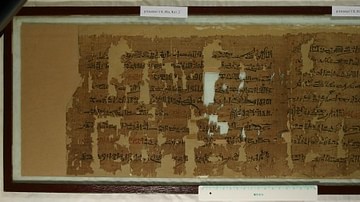
Satire of the Trades
Papyrus Anastasi VII; sheet 1, New Kingdom copy of the Satire of the Trades.
Definition
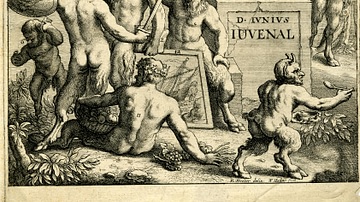
Juvenal
Decimus Junius Juvenalis (l. c. 55-138 CE), better known as Juvenal, was a Roman satirist. He wrote five books, containing 16 satires, each of which criticized a different element of Roman society, whether it was poor housing, the patron/client...

Video
Roman Satire (In Our Time)
Melvyn Bragg and guests discuss Roman Satire. Much of Roman culture was a development of their rich inheritance from the Greeks. But satire was a form the Romans could claim to have invented. The grandfather of Roman satire...

Article
Dialogue of Pessimism - Meaning of Life or Satire?
The Dialogue of Pessimism (circa 1000 BCE) is a Babylonian poem featuring a master and his slave in ten exchanges during which the master proposes an action, and the slave gives reasons for and against...
Article
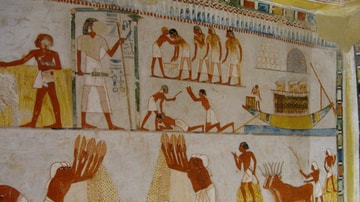
Jobs in Ancient Egypt
In ancient Egypt, the people sustained the government and the government reciprocated. Egypt had no cash economy until the coming of the Persians in 525 BCE. The people worked the land, the government collected the bounty...

Article
Prayer to Thoth for Skill in Writing
The Prayer to Thoth for Skill in Writing is a literary piece dated to c. 1150 BCE from the latter period of the New Kingdom of Egypt (c. 1570- c. 1069 BCE) in which a young scribe prays for inspiration to Thoth...

Definition
Ancient Egyptian Literature
Ancient Egyptian literature comprises a wide array of narrative and poetic forms including inscriptions on tombs, stele, obelisks, and temples; myths, stories, and legends; religious writings; philosophical works; wisdom...

Article
Scribes in Ancient Mesopotamia - The Beginning of History
Scribes in ancient Mesopotamia were highly educated individuals trained in writing and reading on diverse subjects. Initially, their purpose was to record financial transactions through trade, but...
Article
The Sumerian Poem Schooldays - Sumerian Satire & the Scribal Life
Schooldays (written circa 2000 BCE) is a Sumerian poem describing the daily life of a young scribe in the schools of Mesopotamia. The work takes the form of a first-person narration and dialogue...
