
Search
Remove Ads
Advertisement
Search Results

Article
An Ancient City Beneath Rome: Visiting The Catacombs of Priscilla
Any visitor to Rome will want to see and explore the popular historical and cultural sites - the Colosseum, the Forum, the Trevi Fountain and, of course, the Vatican. But a large part of...
Definition
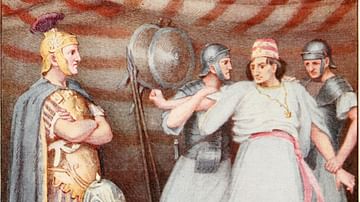
Jugurtha
Jugurtha (r. 118-105 BCE) was King of Numidia in North Africa and grandson of the first Numidian king Masinissa (r. c. 202-148 BCE). He was the illegitimate son of Mastanabal, Masinissa's youngest son, and was the least likely of Masinissa's...

Article
The Fullers of Ancient Rome
The fullers of ancient Rome were launderers who washed the clothes of the city and also finished processing fabric later made into clothing, blankets, or other necessary items. They were looked down upon for their use...

Article
Death's Mansions: The Columbaria of Imperial Rome
A columbarium is an underground chamber, which the Romans used for preserving the ashes of the dead. During the 1st and 2nd centuries CE, hundreds of columbaria lined the consular highways leading out...

Article
Caesarea Maritima's Role in the Roman Empire
Caesarea Maritima, the city Herod the Great (r. 37-4 BCE) built for Rome on the southeastern coast of the Mediterranean served as the Roman Empire's powerbase of operations both commercially and militarily...

Article
The Arch of Constantine, Rome
The Arch of Constantine I, erected in c. 315 CE, stands in Rome and commemorates Roman Emperor Constantine's victory over the Roman tyrant Maxentius on 28th October 312 CE at the battle of Milvian Bridge in Rome. It...

Article
Female Gladiators In Ancient Rome
Female gladiators in ancient Rome – referred to by modern-day scholars as gladiatrix – may have been uncommon but they did exist. Evidence suggests that a number of women participated in the public games of Rome...

Article
Dogs & Their Collars in Ancient Rome
Dogs were highly valued in ancient Rome, as they were in other cultures, and the Roman dog served many of the same purposes as it did in, say, Egypt and Persia - as hunters, guardians, and companions - but with...

Article
Boudicca: Queen of the Iceni, Scourge of Rome
Boudicca (died 61 CE) was the Celtic Queen of the Iceni tribe who led a revolt against Roman occupation of what is now East Anglia, England. So charismatic was Boudicca that ancient sources record tribes...

Article
Rome's Response to the Spread of Christianity
During the 1st century CE, a sect of Jews in Jerusalem claimed that their teacher, Jesus of Nazareth, was the 'messiah' of Israel. 'Messiah' meant 'anointed one', or someone chosen by the God of Israel...
